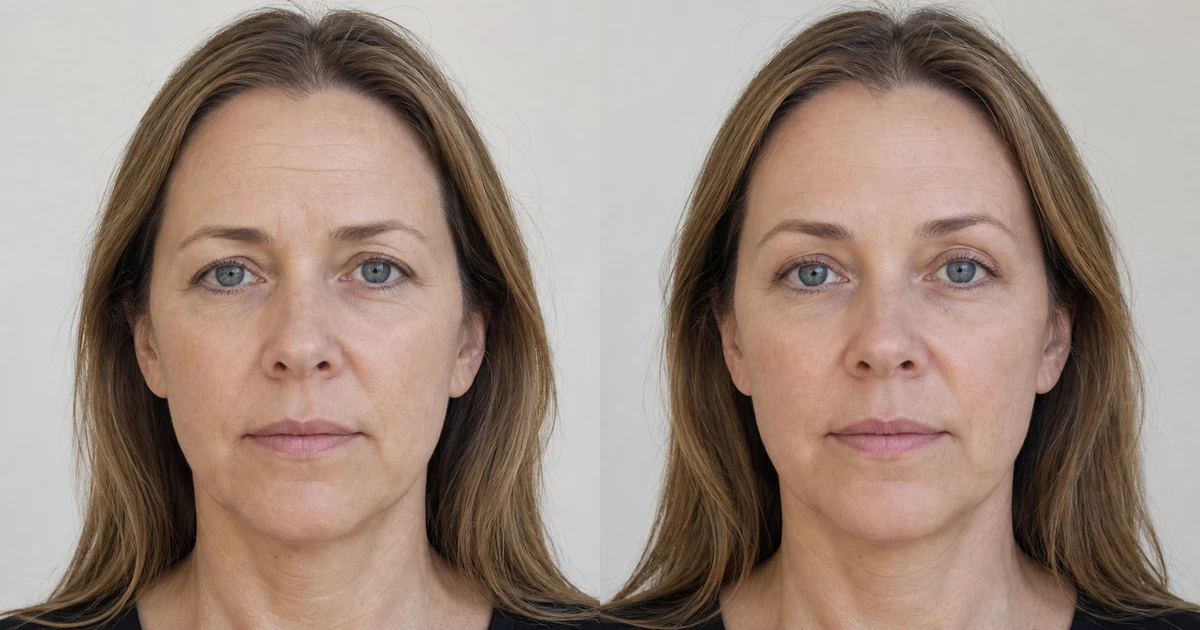
What a Brow Lift Repositions
A brow lift elevates the brow position, smooths transverse forehead lines and — to a lesser extent — softens frown ("11") lines between the eyebrows. But "elevating the brow" is a more layered idea than it sounds, and understanding the layers helps explain both why the operation works and why it can occasionally go wrong.
The forehead is built in bands: skin, a fatty layer, the frontalis muscle (the muscle used to raise the eyebrows), a fibrous sheet called the galea, and the periosteum sitting directly on the skull bone. A brow lift works by releasing the tissue that has been pulling the brow down — usually the small depressor muscles between the brows and at the outer corner of the eye — and then re-securing the brow complex in a higher position, either by anchoring the deeper tissue layer to the skull or by removing a strip of skin above the brow or at the hairline.
The brow itself is not a single flat line that moves as one unit. Surgeons think in terms of three zones — the medial (inner) brow near the nose, the central brow above the pupil, and the lateral (outer) brow toward the temple — and descent is rarely even across all three. Most age-related brow droop is heaviest at the outer third, which is why many modern techniques weight the lift there rather than pulling the whole forehead up uniformly; a uniform lift is one of the classic causes of an artificial-looking result.
It is also worth being clear about what a brow lift does not do. It does not remove crow's feet at the outer corner of the eye — that is a separate skin and muscle concern, often addressed with Botox or resurfacing — and it does not add volume to a hollow temple or a flat brow bone, which would need fat grafting or filler rather than repositioning. Patients who expect a brow lift to resolve everything happening in the upper third of the face are sometimes disappointed even when the surgery itself was executed well, simply because it was never designed to treat those particular concerns.
Brow Lift vs Upper Blepharoplasty
Heavy upper-lid appearance can be caused by two very different things:
- Excess upper-lid skin that sits over the lid margin — the fix is blepharoplasty.
- Brow droop where the brow itself has descended — the fix is a brow lift.
Getting the diagnosis wrong is a common cause of an underwhelming result. If the brow is heavy and the surgeon only removes upper-lid skin, the eye still looks tired within a year or two, because the low brow keeps pushing tissue back down onto the lid margin. Some patients need both operations at once, or need blepharoplasty first and a brow lift later as a second stage once it becomes clear how much of the heaviness the eyelid surgery alone resolved.
There is a simple self-check surgeons sometimes describe, though it is no substitute for an in-person assessment: in a mirror, gently push each brow upward with a fingertip to roughly where it sat in earlier years. If the hooding over the lid disappears completely, brow position is playing a meaningful role and a lift is worth discussing. If pushing the brow up makes little visible difference and the excess skin still rests on the lashes, the problem is more likely skin volume on the lid itself, pointing toward blepharoplasty. Many patients find the honest answer is both — a mild brow droop layered on top of genuinely excess lid skin — and in that case the two procedures are sometimes combined in a single operation, and a single recovery. For the complementary view of this same distinction, see the blepharoplasty guide.
Techniques
- Endoscopic: small incisions behind the hairline plus keyhole cameras. Least scarring. Modest lifts.
- Temporal (limited incision): incisions in the temples. Good for lifting the outer brow.
- Coronal (open): long incision across the top of the scalp. Historical technique, still used for larger lifts, larger scar.
An endoscopic lift typically uses three or more short stab incisions hidden just behind the hairline, rather than the single ear-to-ear incision used in a coronal lift; a narrow camera and instruments pass through them to release the depressor tissue and lift the sagging brow, reducing transverse forehead lines and the vertical frown lines between the eyebrows in the process2. The repositioned brow is usually secured with dissolvable anchors or small screws in the outer table of the skull. Recovery tends to be faster than with open techniques because less tissue is disturbed, though swelling around the eyes typically takes a few weeks to settle. It suits a mild-to-moderate droop in patients whose hairline isn't receding, since a very high or thinning hairline makes the small scars harder to conceal.
A temporal or limited-incision lift confines the surgery to the temples and focuses the effect on the outer third of the brow — the zone that droops earliest and most visibly — without touching the central forehead, and it is often combined with upper blepharoplasty in one session. A coronal (open) lift runs a single incision from ear to ear across the scalp, giving the surgeon direct-vision control over larger degrees of lift; it remains useful for a significant droop or a very high, receding hairline where an endoscopic approach isn't practical, but it carries a longer hidden scar, a longer recovery, and a higher chance of temporary numbness across the scalp behind the incision.
Across all three approaches, the supraorbital and supratrochlear nerves — which supply sensation to the forehead and scalp — run close to the surgical field, so temporary tingling or numbness above the brow is common in the first weeks and, less often, persists longer: a clinical review of brow lift surgery found forehead paraesthesia or numbness in a large majority of patients afterwards, though most were not significantly bothered by it3. As with any surgical cosmetic procedure, technique choice also affects the general risks — bleeding, infection, an anaesthetic reaction — set out in NHS.uk's general advice on cosmetic procedures1, as a general starting point before any procedure-specific discussion with a surgeon. The right technique depends far more on the pattern and severity of the droop, hairline position and hair density than on patient preference, which is why it is usually decided by the surgeon after examination.
The "Surprised Look" Concern
Over-elevation gives an unnatural, permanently startled appearance — arched brows, a wide, staring look even at rest, and a smooth forehead that no longer moves naturally with expression. It happens for a few specific reasons: tissue fixed too high during surgery, too much skin or muscle removed so the brow cannot settle back down once swelling resolves, or uneven fixation so one brow sits higher than the other, which is a separate asymmetry problem distinct from a simple bilateral over-lift.
Current UK practice favours modest, brow-specific repositioning — lifting the areas that have genuinely dropped, usually weighted toward the outer brow, rather than blanket elevation of the whole forehead. This reflects a broader shift in the specialty: earlier coronal techniques were more prone to over-correction, and much of the "surprised" look associated with brow lifts in public perception comes from that earlier era rather than from how the surgery is typically planned today.
Because the result is difficult to reverse once tissue has healed into a new position, prevention matters more than correction after the fact. Show your surgeon photos of yourself from your 20s or 30s, if you have them, as a natural reference point for where the brow used to sit. Ask specifically how many millimetres of lift are planned for each zone of the brow, and ask to see the surgeon's own before-and-after cases in patients with a similar starting brow shape, not only their most flattering results. If over-elevation does occur, revision surgery is possible but technically more demanding than the original operation, and it cannot always fully restore a natural brow position — another reason a conservative first surgery is generally preferred to an aggressive one.
Reading Result Photos
- Neutral expression: a raised eyebrow at the moment of the photo overstates the lift.
- Consistent angle: a chin-tucked-down before with a chin-up after exaggerates the change.
- Timing: initial post-op swelling temporarily lifts the forehead — 3-month photos are the honest ones.
Lighting deserves the same scrutiny as angle: a dim, flat "before" photo next to a bright, well-lit "after" photo will make almost any forehead look smoother and any brow look higher, independent of what the surgery actually achieved. Six-to-twelve-month photos, once any residual swelling has fully settled and scars have matured, are more reliable again than three-month images, though three months is usually an honest enough checkpoint for most galleries.
It is also worth checking the hairline and hairstyle used in the "after" photo — a fringe or styled hair conveniently covering the incision area tells you little about the scar itself — and, where possible, looking for a second, unposed photo of the same patient smiling or raising their eyebrows naturally. A forehead that can no longer move at all in an unposed shot is not necessarily a desirable outcome, and a gallery that only ever shows static, neutral "after" photos makes it harder to judge how the result behaves in motion, which is exactly when an over-lifted brow tends to give itself away.
Longevity & Botox as a Temporary Alternative
Surgical brow lift results last many years but not permanently — forehead skin continues to relax with age, and how quickly that happens depends on skin quality, cumulative sun exposure, smoking history and genetics, much the same factors that govern how any facial skin ages over time. The type of fixation used during surgery can make a modest difference to durability too: permanent sutures or small titanium screws anchoring the tissue to the skull tend to hold position slightly longer than dissolvable anchors, though the underlying skin will continue to age regardless of which fixation method was used.
Botulinum toxin (Botox) is sometimes discussed as a non-surgical, temporary alternative for the forehead. According to BAAPS's patient information on botulinum toxin injections4, its effects generally last around three to four months. It works by relaxing the muscles that pull the forehead down, which can soften transverse lines, but it does not reposition tissue that has already stretched or descended and doesn't remove any excess skin — and, notably, slight drooping of the treated brow or eyelid is itself a recognised, if uncommon, side effect of the injections rather than a lifting effect4. It is best understood as a temporary softening of forehead lines rather than a genuine alternative for anyone with a meaningful brow droop or heavy upper lids, since those are structural changes that only surgery addresses directly.
FAQ
Do I need a brow lift or eyelid surgery?
Heavy upper eyelids can come from excess eyelid skin, from the brow itself having dropped, or from both together. A surgeon assesses brow position and eyelid skin separately during consultation, because removing eyelid skin alone won't fix a low brow, and a brow lift alone won't fix true eyelid skin excess.
Will I look surprised?
A permanently startled look results from lifting the brow too high or removing too much tissue, and is more associated with older, aggressive techniques than with modern conservative brow lifts. Ask to see your surgeon's own before-and-after cases at rest, not mid-expression, and discuss exactly how many millimetres of lift is planned before agreeing to surgery.
How long does it last?
A surgical brow lift's results typically last many years — often a decade or more — because the tissue is physically repositioned rather than temporarily relaxed. The brow and forehead skin continue to age afterward, so position gradually softens over time, but the procedure itself is not undone the way a non-surgical treatment would be.