Septoplasty vs Rhinoplasty vs Septorhinoplasty
These three terms get used loosely, but they describe different operations with different aims — and confusing them is the most common reason people misjudge what the NHS can and can't offer. Septoplasty corrects the internal structure of the nose, specifically the septum — the wall of cartilage and bone dividing the two nostrils — to relieve breathing obstruction. It does not change how the nose looks from the outside. Rhinoplasty reshapes the external appearance: the bridge, tip, nostril width or overall proportions. Septorhinoplasty combines both in one operation, correcting a functional problem and reshaping appearance at the same time.
This distinction is exactly where NHS funding policy draws its line: as the NHS.uk page on nose reshaping (rhinoplasty)1 puts it, surgery is "not usually available on the NHS for cosmetic reasons, but may be provided on the NHS if it's needed to help you breathe." In practice, this means the septoplasty element of an operation can, in principle, be assessed on functional grounds, while the rhinoplasty element — the part that changes appearance — is treated as cosmetic and is not funded, even when performed in the same operation as a septoplasty. As the British Association of Aesthetic Plastic Surgeons' rhinoplasty patient information2 also makes clear, this functional/cosmetic split is fundamental to how rhinoplasty is planned and discussed by surgeons generally — not an NHS technicality invented to say no.
When Breathing Problems May Qualify
ICBs may consider funding the functional element of surgery where there is documented evidence of a genuine structural problem, such as:
- Chronic nasal obstruction or breathing difficulty attributable to septal deviation, confirmed on examination rather than reported alone.
- Nasal deformity or airway obstruction following trauma — a broken nose, sports injury or road traffic collision — where the injury can be dated and linked to the current problem.
- Recurrent sinus problems plausibly linked to structural obstruction, usually alongside ENT input.
- Obstruction severe enough to affect sleep, exercise tolerance, or day-to-day breathing through one or both nostrils.
As with all NHS cosmetic-adjacent procedures, NHS.uk1 is clear that there is no automatic entitlement — funding decisions sit with your regional Integrated Care Board (ICB), and policy varies by area. This kind of regional variation is a recognised feature of NHS cosmetic-adjacent commissioning more broadly — the Royal College of Surgeons of England and BAPRAS's commissioning guide for cosmetic surgery following massive weight loss3 is one example of national guidance issued precisely because local policy would otherwise diverge significantly. A request driven mainly by dissatisfaction with the nose's shape will not meet functional criteria, even when submitted alongside a genuine breathing complaint — the two have to be assessed, and often described, separately.
What the NHS Typically Won't Fund
It's worth being explicit about what falls outside NHS funding, because this is where most enquiries end in disappointment. The NHS will not fund rhinoplasty for:
- Dislike of a dorsal hump, a wide or bulbous tip, or asymmetry that isn't linked to a breathing problem.
- A nose shape that doesn't match a patient's aesthetic preference, including requests to change ethnic features of the nose.
- Revision of a previous, privately performed cosmetic rhinoplasty that hasn't produced the appearance the patient wanted.
- Mild septal deviation found incidentally, with no meaningful breathing symptoms attached to it.
None of this means the concern isn't valid — it means it sits in the private, cosmetic category rather than the NHS functional pathway. Being clear from the outset about which problem you're asking to have addressed, rather than blending a shape preference into a breathing complaint, tends to produce a more useful conversation with your GP and a cleaner referral if one is appropriate.
How to Start: GP Referral to ENT
Your GP is the starting point. They will take a history to establish whether your symptoms suggest a genuinely functional cause and, if so, refer you to an ENT (ear, nose and throat) surgeon or a plastic surgeon with an interest in nasal airway function. Assessment commonly includes:
- A detailed history of breathing difficulty — when it started, whether one or both sides are affected, and any history of trauma.
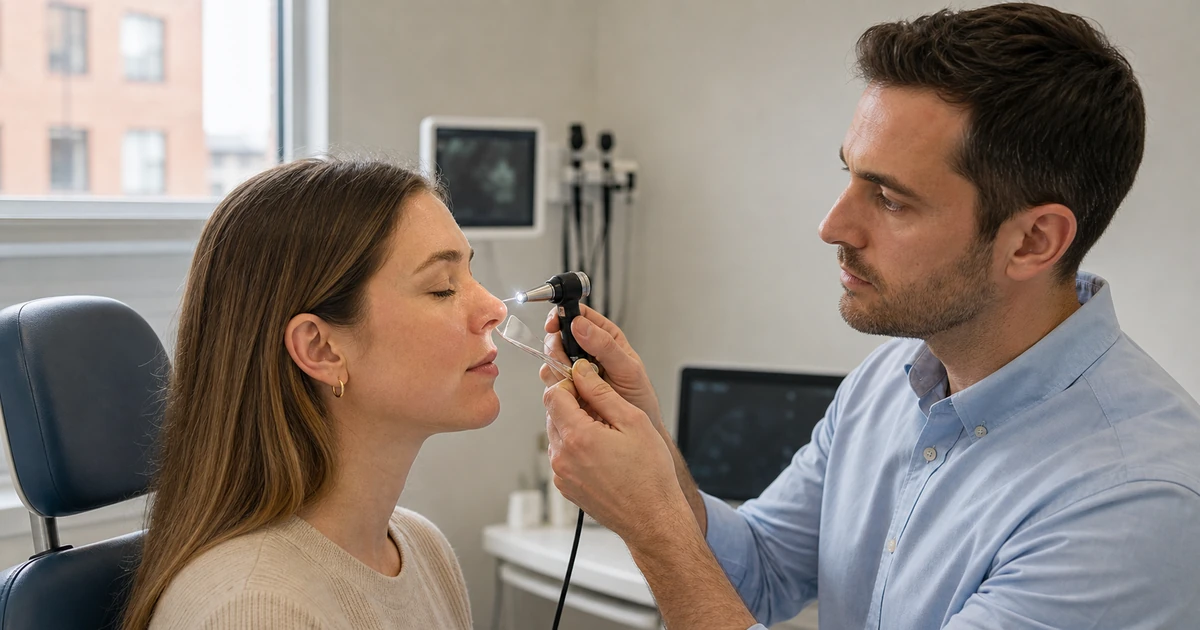
- Physical examination of the septum and nasal passages.
- Nasal endoscopy in some cases, to visualise the obstruction directly using a small camera.
- A trial of conservative treatment first — nasal steroid sprays, treating any underlying allergies — where clinically appropriate, before surgery is considered.
If a structural cause is confirmed and conservative measures haven't resolved it, the specialist can support a referral for septoplasty or septorhinoplasty under local ICB policy. Bring a clear, dated history of your breathing difficulty, note any nasal trauma with approximate dates, list treatments already tried and whether they helped, and be ready to separate — in your own mind — the functional complaint from any cosmetic preference, since your GP and the specialist will need to do the same.
Waiting times between GP referral and a first ENT appointment vary by area and by how the referral is coded — a straightforward breathing complaint may be seen sooner than one bundled with a cosmetic request, since the latter often needs extra clarification before it's triaged correctly. Once you're seen, further tests such as endoscopy are not always done at the first appointment; some ICBs require a documented period of conservative treatment to have failed before diagnostic imaging or a surgical decision is made, so it's worth asking your ENT team what the expected next steps and rough timescale look like for your case specifically.
If the Functional Repair Doesn't Change Appearance
It's worth setting this expectation early: septoplasty is designed to fix breathing, not to reshape the nose. Where surgery is funded purely as a septoplasty, the external appearance of your nose afterwards should look essentially the same as before — that's by design, not a shortfall in the surgery. Some patients are surprised, after months of anticipating an operation, that a straightened septum hasn't also straightened a visible bump or asymmetry they'd separately hoped would improve.
Where septorhinoplasty is being discussed — combining a functional repair with reshaping — it's important to understand which parts of that combined plan the NHS is actually funding, and which, if any, remain a private cosmetic add-on you'd need to pay for separately. The GMC's guidance for doctors who offer cosmetic interventions4 requires doctors to give patients enough balanced information, before they consent to any procedure with a cosmetic element, to hold realistic expectations of the outcome. Ask your surgeon directly, before your operation, exactly what will and won't change about how your nose looks.
Outside Standard Policy: The IFR Route
If your case doesn't clearly fit local policy but you and your clinician believe there are exceptional circumstances, the mechanism is an Individual Funding Request (IFR). It's submitted by your clinician, not by you directly, and requires a case for clinical exceptionality — that your circumstances are materially different from the general population the policy addresses. Read Individual Funding Requests for the full process, including what evidence panels look for and how long a decision typically takes.
Going Private: Cost
Cosmetic rhinoplasty, and functional requests that are refused, are both commonly pursued privately in the UK. Typical UK private costs are £5,500–£9,500 for primary rhinoplasty, rising to £6,500–£10,500 where septorhinoplasty combines functional and cosmetic work in one operation, and £8,000–£12,000+ for revision surgery on a previously operated nose. See the Rhinoplasty cost guide for what a written quote should include, and how the surgery works for how the operation is performed and what recovery involves.
FAQ
Can I get a nose job on the NHS?
Not for cosmetic reasons — that is never NHS-funded. If you have a genuine breathing problem caused by a structural issue such as a deviated septum, septoplasty or septorhinoplasty may be considered, subject to your ICB's policy and clinical assessment.
What about a deviated septum — does that help my case?
A deviated septum causing documented breathing difficulty is the most common reason funding for septoplasty is considered. It must be confirmed on physical examination or nasal endoscopy, not just reported by you, and conservative treatments such as nasal steroid sprays are usually tried first before surgery is discussed.
Will surgery change how my nose looks?
An NHS-funded septoplasty is designed purely to improve breathing, so your nose should look much the same afterwards — that's by design, not a shortfall in the operation. Only the cosmetic, reshaping element of a combined septorhinoplasty changes external appearance, and that specific element is never NHS-funded.
What's the difference between septoplasty and rhinoplasty?
Septoplasty corrects the internal structure of the nose — the septum — to improve breathing, without changing how the nose looks. Rhinoplasty reshapes the external appearance. Septorhinoplasty combines both in one operation. The NHS funding route only ever applies to the functional, breathing-related septoplasty element.
What if my request is refused?
You're entitled to a written decision explaining the reasoning, and there's a formal appeal route. An Individual Funding Request may also be an option where there are genuinely exceptional circumstances. If neither route succeeds, private cost is typically £5,500–£9,500 for primary rhinoplasty, more for septorhinoplasty or revision work.