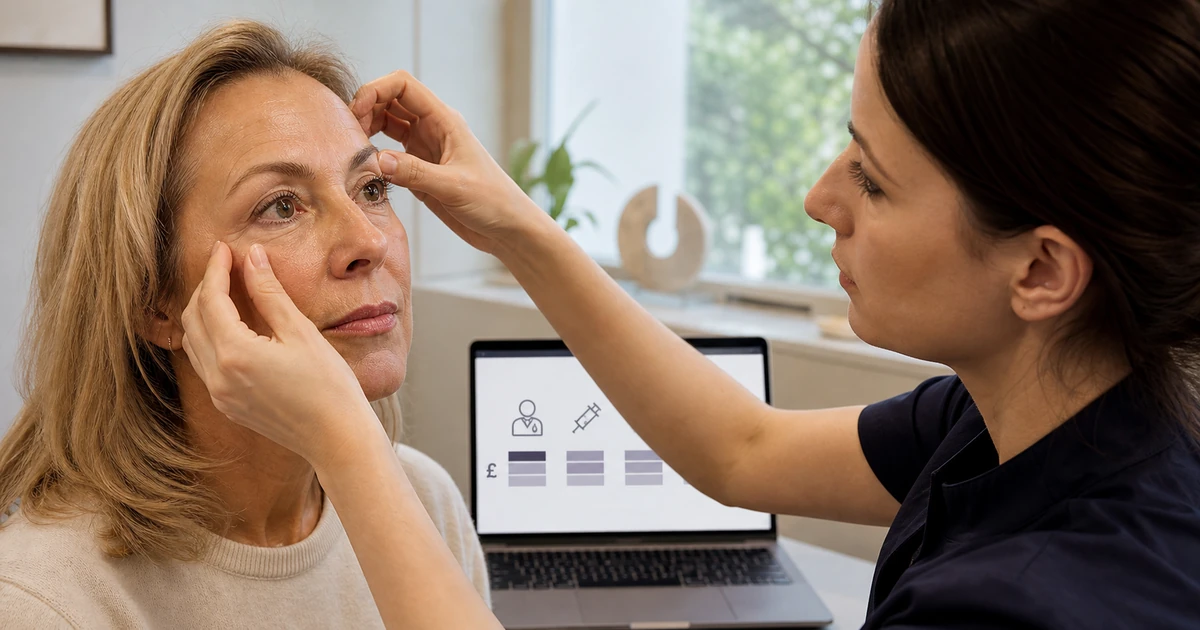
Typical £ Ranges
Eyelid surgery isn't a single price point — upper, lower and combined blepharoplasty are different operations with different theatre time, technical demands and anaesthetic requirements, and UK private fees reflect that. The table below sets out the typical ranges quoted by UK clinics; treat it as a starting point for comparison rather than a fixed tariff, since every written quote should reflect your own anatomy, the technique proposed and the facility used.
| Type | Typical UK range | Notes |
|---|---|---|
| Upper eyelid blepharoplasty | £3,000 – £4,500 | Removes excess upper lid skin/fat; often local anaesthetic |
| Lower eyelid blepharoplasty | £4,000 – £6,000 | Addresses under-eye bags, laxity; more technically demanding |
| Combined upper + lower | £5,500 – £7,500+ | Single anaesthetic, longer theatre time |
Ranges reflect UK private-sector guidance from BAAPS eyelid surgery (blepharoplasty) patient information1 and clinic-published fees. Prices vary; get personal written quotes.
Why Lower Lids Often Cost More
Patients are often surprised that lower eyelid surgery costs more than upper — the eye looks smaller from the outside, so it's easy to assume it's the simpler half of the operation. It isn't. Upper lid surgery is largely a skin-and-fat excision performed close to the surface, often achievable under local anaesthetic alone. Lower lid work operates in a technically tighter space, closer to structures that support the eye itself, and commonly involves repositioning rather than simply removing fat — a technique aimed at avoiding the hollow, "operated" look that crude fat removal can leave behind.
That technical difference has real consequences for price. Lower lid surgery typically takes longer in theatre, is more often performed under sedation or general anaesthesia rather than local anaesthetic alone, and carries a narrower margin for error around the lower lid margin itself — over-aggressive lower lid surgery can pull the lid down (ectropion), a complication surgeons actively work to avoid through careful technique and, sometimes, an additional support suture. Combining both procedures in one session adds further theatre time and typically pushes total cost toward the top of the combined range.
Degree of Ptosis vs Straightforward Excess Skin
Not every upper lid case is priced the same, either. Straightforward excess-skin removal is a different operation to one involving ptosis — a drooping eyelid caused by a weakened or stretched lid-lifting muscle (the levator) rather than simple skin excess. Ptosis correction requires the surgeon to identify and tighten that muscle precisely, which is a more technically demanding step than skin excision alone and is usually reflected in a higher quote. See Ptosis or Excess Skin? Why the Diagnosis Changes Your Surgery if you're not sure which applies to you — misdiagnosing the two is a common cause of a disappointing result.
Surgeon Experience & Facility Type
Oculoplastic and facial plastic surgeons with high blepharoplasty volumes typically price at the upper end of the range. A hospital theatre with recovery facilities and anaesthetist support on site also costs more to run than a smaller day-case clinic — a difference that shows up in the facility fee line of your quote, independent of the surgeon's own fee. Where an oculoplastic specialist is jointly managing a functional element alongside a cosmetic one — for example, a small amount of ptosis correction combined with cosmetic skin removal — expect the quote to reflect both the surgical time and the additional expertise involved, even if only part of the procedure would ever meet NHS functional criteria.
What's Included / What's Not
What a Quote Should Include
- Surgeon's fee (named surgeon).
- Anaesthetist's fee — most upper lid blepharoplasty is done under local anaesthetic with sedation, but any sedation/anaesthetic provider should still be named separately.
- Clinic or hospital facility fee.
- Post-operative dressings and lubricating eye drops/ointment — needed for several weeks while the lids settle.
- Named follow-up appointments (how many, over what period, and whether they're in person).
- Written revision policy, including what — if anything — is covered if asymmetry or under-correction needs a further procedure.
What's Often Left Out
- Time off work — typically 1–2 weeks, longer if bruising is significant or your role is physically demanding.
- Sunglasses and cold compresses for early recovery — small costs, but ones people forget to budget for.
- A second in-person consultation before you sign, separate from the initial assessment.
- Travel and accommodation for out-of-town clinics, including any return trip for suture removal.
- Any revision surgery fee, should the result need refining once swelling has fully settled.
Functional Cases and the NHS
Cosmetic eyelid surgery — improving the appearance of tired or heavy-looking eyes — is not funded by the NHS under any circumstances, and is treated purely as a private procedure on the NHS.uk eyelid surgery page2. The one exception is genuinely functional: where excess upper eyelid skin has progressed to the point that it physically obstructs the visual field. In practice, individual ICBs typically require that obstruction to be demonstrated clinically — commonly through a visual-field test carried out by an ophthalmologist or optometrist — rather than simply reported by the patient, though the exact evidence expected is set by local policy rather than a single national standard.
Even where a visual-field deficit is confirmed, funding is never automatic. Decisions are made by your local Integrated Care Board (ICB) against locally published criteria, a pattern that applies across NHS cosmetic-adjacent procedures generally, as set out in NHS.uk's guide to NHS funding criteria for cosmetic procedures3. Two people with visually similar drooping lids can receive different funding decisions depending on their region and the precise severity recorded on testing. See Cosmetic Surgery on the NHS for how this ICB-by-ICB variation works across procedures more broadly, and talk to your GP or an ophthalmologist first if you suspect a functional element — pursuing that route before assuming you'll need to self-fund can save a substantial sum if you do meet criteria.
Local vs General Anaesthetic: Cost Impact
Anaesthetic choice is one of the more overlooked cost drivers in eyelid surgery. Upper lid blepharoplasty alone is frequently performed under local anaesthetic, sometimes with light oral or intravenous sedation to keep you comfortable — this avoids the fee for a consultant anaesthetist administering a general anaesthetic and the additional recovery-room time that follows it, and is one reason upper lid surgery sits at the lower end of the overall price table.
Lower lid and combined procedures are more often performed under sedation or full general anaesthesia, partly because the operation takes longer and partly because working precisely around the lower lid for an extended period is more comfortable for the patient under deeper sedation. A general anaesthetic adds the anaesthetist's professional fee, additional monitoring equipment and staff time, and typically a longer stay in recovery before you're discharged — all of which appear as separate line items on a properly itemised quote. If cost is a significant factor, it's worth asking directly at consultation whether your case is suitable for local anaesthetic with sedation rather than a full general anaesthetic, though the decision should ultimately rest on what's clinically appropriate for your surgery, not on price alone. Some clinics quote a single all-in figure regardless of anaesthetic type; others itemise it separately, which makes it easier to see exactly what you're paying for and to compare quotes between clinics using different anaesthetic approaches for the same operation.
Recovery Time and Its Cost Impact
Bruising and swelling typically peak in the first week and settle substantially over 2–3 weeks, though subtle swelling can take longer to fully resolve. Planning realistic time off work reduces the chance of needing extra unpaid leave or returning to a visible, still-healing result too early. See the full eyelid surgery recovery guide for a day-by-day timeline, and the blepharoplasty procedure guide for how upper, lower and combined surgery are actually performed.
London vs the Rest of the UK
London typically sits 15–30% above regional cities for the same procedure, driven mainly by facility overheads and demand for high-volume oculoplastic surgeons based in the capital. Read London vs Rest of UK for the wider picture and the practical trade-offs of travelling within the UK for a lower price, including how follow-up care works if your clinic isn't local.
Paying Privately: Finance
Personal loans, medical finance and clinic payment plans are the common routes patients use to spread the cost of eyelid surgery. We do not recommend specific providers. See Finance & Payment for the questions to ask before signing any agreement, including what happens financially if a revision is needed later.
How to Compare Quotes Safely
- Compare quotes with the same components — surgeon, anaesthetist, facility, dressings, follow-up, revision policy.
- A suspiciously cheap outlier is a question, not a bargain — ask specifically what's excluded.
- Pressure to book today, or a discount that expires within 24 hours, is a red flag, not a deal.
- Insist on a written revision policy before you sign anything.
FAQ
How much is eyelid surgery in the UK?
Typically £3,000–£4,500 for upper lid surgery, £4,000–£6,000 for lower lid, and £5,500–£7,500+ for combined surgery, privately. Lower lid work costs more because it's technically harder and more often needs sedation or general anaesthesia.
Is it cheaper under local anaesthetic?
Generally yes. Local anaesthetic with light sedation avoids a full anaesthetist's fee and extended recovery-room time, which is one reason upper lid surgery alone often costs less than lower lid or combined procedures.
Can the NHS fund it?
Only rarely, when excess upper eyelid skin is shown on formal visual-field testing to obstruct your sight. Purely cosmetic cases are never funded, and even qualifying cases depend on your local ICB's criteria.