Why Recovery Differs Between Augmentation, Lift and Reduction
It's tempting to treat "breast surgery recovery" as a single timeline, but augmentation, lift and reduction involve genuinely different amounts of tissue disruption. Augmentation places an implant, generally through a relatively small incision, without removing tissue — recovery is largely about the body adjusting to a new implant and settling swelling around it. A lift repositions the nipple and reshapes the skin envelope without necessarily adding or removing significant volume, so the healing burden sits mainly in the skin and the repositioned tissue. Reduction removes glandular tissue, fat and skin outright, which means more internal healing, more drain or dressing management in the first days for some patients, and a longer stretch before normal upper-body movement feels comfortable. If your procedure combines two of these — a lift with implants, for example — expect a recovery that leans toward the more involved half of the combination, not simply an average of the two.
Support Garments and Compression
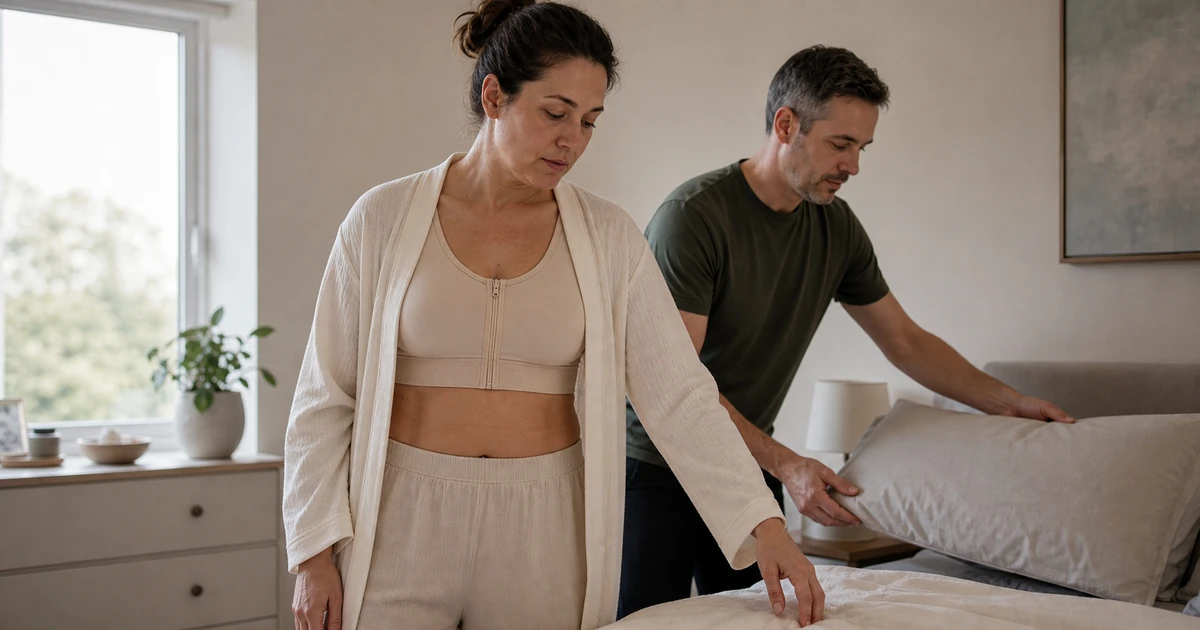
After breast augmentation, lift or reduction, most surgeons ask patients to wear a supportive or compression garment for around 4–6 weeks — a widely followed practice also reflected in the British Association of Aesthetic Plastic Surgeons' patient information on breast surgery2. This helps control swelling, supports healing tissue, and helps skin settle around the new breast shape. Some surgeons specify a particular type of garment — a soft surgical bra without underwire, for instance — rather than any supportive bra, so follow your own surgeon's specific instructions on the type, and on when it can come off for showering and sleeping.
Sleeping Position in Early Recovery
Across all three procedures, sleeping on your back with your upper body slightly elevated — using extra pillows or a recliner — is the most commonly recommended position for the first couple of weeks. This reduces pressure and swelling around healing tissue and lowers the chance of accidentally rolling onto the chest during sleep. Side or front sleeping is usually reintroduced gradually once your surgeon confirms the healing tissue can tolerate the pressure, which for many patients is somewhere around the 3–6 week mark, though this varies by procedure and by how you personally heal. Ask your surgeon for guidance specific to your operation rather than assuming a generic timeline applies.
Breast Augmentation: The "Drop and Fluff" Process
As NHS.uk's page on breast enlargement (breast implants)1 notes, breasts should start to look and feel more natural over the months after implant surgery as they settle into their final position and appearance. Immediately after augmentation, implants often sit slightly high and the breasts can look firm or rounded at the top — this is normal and temporary. Over the following weeks to a few months, the implant gradually settles ("drops") into a more natural position on the chest wall as tissues relax, and the surrounding breast tissue softens around it ("fluffs"). The exact pace varies between patients and implant placement, so the shape you see at 2 weeks is not the shape you'll have at 3 months.
Breast Lift: How Recovery Differs From Augmentation
A standalone breast lift, without implants, has no "drop and fluff" phase in the same sense, because there's no implant settling into position — instead, the skin envelope and repositioned nipple need time to soften and for scars to mature. Swelling in a lift-only procedure tends to resolve on a broadly similar timeline to augmentation, but the shape you see is closer to the final shape sooner, since it isn't waiting on an implant to settle. Where a lift is combined with implants in the same operation, expect the combined recovery, including both the implant-settling process and the skin/scar healing of the lift, to run on the longer of the two individual timelines rather than a shorter blended one.
Activity Restrictions
Across augmentation, lift and reduction, upper-body exercise — lifting, pushing, overhead movement, running, and anything that jolts the chest — is generally restricted for around 6 weeks while internal healing progresses. Gentle walking is usually encouraged much earlier to support circulation. Return-to-work timing differs by procedure and by how physical your job is:
- Breast augmentation: office-based work around 1 week; full activity, including exercise, around 6 weeks.
- Breast reduction: office-based work typically 2–3 weeks, reflecting the larger amount of tissue work involved.
- Breast lift: broadly similar to augmentation for most patients, though this varies with the technique used and whether implants are combined.
Manual or physically demanding jobs — anything involving regular lifting, reaching overhead, or driving for a living — typically need longer than these office-based estimates across all three procedures; talk to your surgeon about your specific role rather than assuming the general figure applies. Driving is usually avoided until you can comfortably wear a seatbelt across the chest and perform an emergency stop without pain or hesitation — discuss timing with your surgeon and see our time off work and driving guide for the general UK principles.
Scar Maturation: 12–18 Months
Breast surgery scars follow a predictable maturation pattern, though the exact rate varies by individual:
- Around 6 weeks: scars are typically red or pink and slightly raised.
- Around 3 months: scars usually soften and fade toward pink.
- 12–18 months: scars generally reach their final, pale, flat appearance.
See our dedicated guide to scars and healing for practical scar-care measures such as silicone sheets and sun protection. Patient information from the British Association of Plastic, Reconstructive and Aesthetic Surgeons3 covers the same breast-specific scar patterns — around the areola, in the inframammary fold, or vertically down the breast, depending on technique — and how they're expected to mature.
Breast Reduction: Symptom Relief Follows a Different Curve
For reduction patients specifically, part of "recovery" is also about how quickly physical symptoms improve, not just how the incisions heal. The back, neck and shoulder pain, bra-strap grooving and skin irritation beneath the breast associated with an overly large breast size are well documented as reasons for surgery in the RCS England/BAPRAS commissioning guide on breast reduction surgery5, and are widely reported by patients to improve after surgery. Separately, a systematic review of patient-reported (BREAST-Q) outcomes after reduction mammaplasty4 found consistent improvement across composite measures of physical wellbeing, psychosocial wellbeing, sexual wellbeing and overall satisfaction — often noticeable well before the scars themselves have fully matured. It's worth knowing that symptom relief and cosmetic scar maturation run on different clocks, so feeling physically better within weeks doesn't mean the visible result is finished yet.
Recovery by Procedure
For procedure-specific detail beyond this overview, see:
- Breast augmentation: the surgery explained
- Breast lift: the surgery explained
- Breast reduction: the surgery explained
- Breast lift before & after
- Breast reduction before & after
- Breast surgery cost breakdown
When to Seek Help
Contact your clinic promptly for increasing pain, spreading redness, discharge, fever, or a hard, sudden new swelling in one breast. For chest pain, breathing difficulty or signs of severe bleeding, this is a 999 emergency. See our full warning signs guide for the complete NHS 111 vs 999 breakdown.
FAQ
How long do I need to wear a support bra after breast surgery?
Most surgeons recommend a support or compression garment for around 4–6 weeks across augmentation, lift and reduction, though your own surgeon's instructions on the exact type and timing take priority over any general figure quoted here.
What does "drop and fluff" mean after breast augmentation?
It describes the gradual process, over weeks to a few months, where implants settle into a more natural lower position and the surrounding tissue softens around them. It applies specifically to augmentation; a standalone breast lift doesn't go through the same implant-settling phase.
Is breast lift recovery the same as augmentation?
Broadly similar for most patients, but not identical — a lift has no implant "drop and fluff" phase, so its visible shape settles sooner. If implants are combined with a lift, expect recovery to follow the longer of the two individual timelines rather than a quicker blended one.
When can I go back to work after breast reduction?
Most patients return to office-based work around 2–3 weeks after breast reduction, reflecting the larger amount of tissue work compared with augmentation. Physically demanding jobs typically need longer — discuss your specific role and duties with your surgeon before setting a return date.
How long until breast surgery scars fade?
Scars typically mature over 12–18 months, moving from red and raised around 6 weeks, to pink around 3 months, to pale and flat by 12–18 months. This pattern is broadly the same across augmentation, lift and reduction, regardless of exactly where the incision sits.