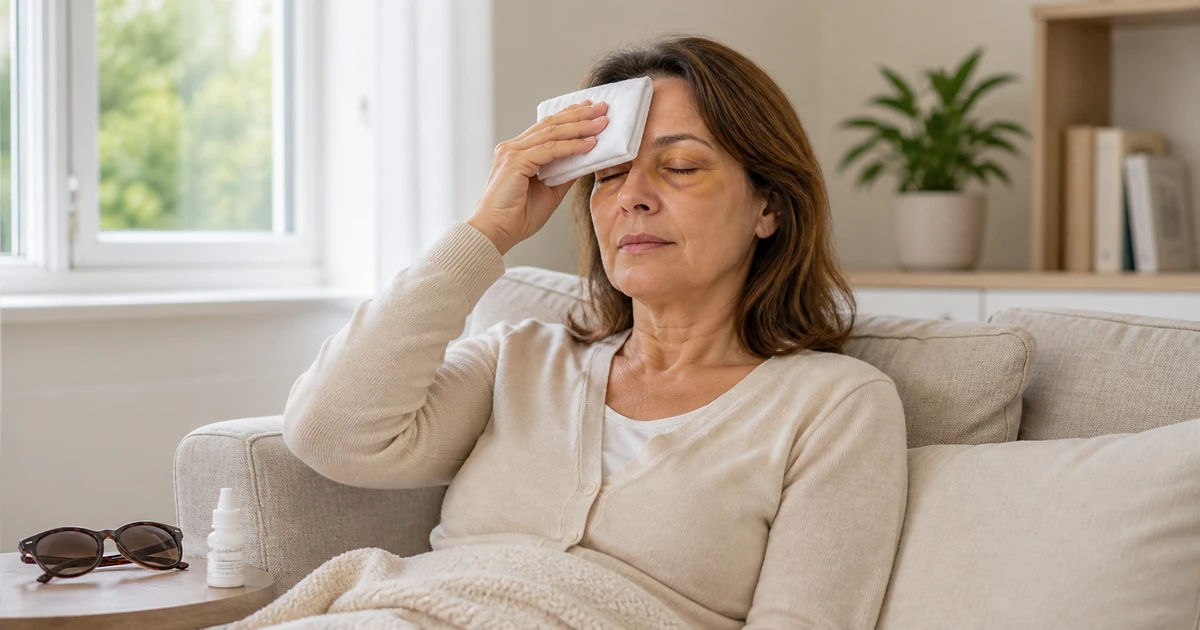
The First Few Days: Swelling, Bruising and Tight Eyelids
As NHS.uk's page on eyelid surgery1 explains, it's normal for the eyelids and surrounding skin to be swollen, bruised and tight in the days immediately after surgery. Cold compresses (as advised by your surgeon) and sleeping with your head elevated on two or three pillows can help reduce swelling and encourage fluid to drain away from the face overnight. Vision may feel slightly blurry from lubricating ointment or mild swelling — this is expected and temporary, and it is not the same thing as a genuine change in eyesight. Some general grogginess, mild nausea or a sore throat in the first day can also simply reflect recovering from the general anaesthetic itself, as covered by the NHS.uk page on recovering from a general anaesthetic2, separate from the eyelid-specific healing.
Most surgeons ask patients to avoid bending forward, heavy lifting and strenuous activity for the first week or so, since raised blood pressure in the head and neck can worsen swelling and bruising. Someone should ideally drive you home and stay with you for the first night, since vision can be temporarily blurred and you may still be feeling the effects of sedation or a general anaesthetic.
Stitch Removal: Around Day 5–7
If non-dissolvable stitches were used, they are typically removed at a short, straightforward appointment around 5–7 days after surgery. Dissolvable stitches, where used instead, don't need a separate removal visit but the timeline for visible healing is similar. Either way, this appointment is also a useful checkpoint for your surgeon to confirm healing is on track before you resume contact lenses, makeup or more normal activity.
The Dry-Eye Phase: Why It Happens
A temporary dry, gritty or irritated feeling in the eyes is a well-recognised part of early blepharoplasty recovery. In general terms, swelling around the eyelid can briefly reduce how completely you blink, and the normal tear film that keeps the eye's surface comfortable can be temporarily disrupted while tissues heal. This usually settles as swelling reduces and normal blinking mechanics return over the first couple of weeks. Lubricating eye drops are commonly recommended during this phase — follow your surgeon's specific product and timing advice rather than using anything not approved for post-surgical use.
When Can I Wear Contact Lenses Again?
Contact lenses are generally paused for longer than glasses after blepharoplasty, because the combination of eyelid swelling, temporary dry eye and a healing incision close to the lid margin makes lenses uncomfortable and, in the early days, best avoided altogether. As a general rule, most surgeons ask patients to stay out of contact lenses for at least the first 1–2 weeks, and sometimes longer if dryness or swelling is still settling. Glasses are a straightforward substitute during this period. Don't restart lenses on your own timetable — check with your surgeon at a follow-up appointment, since the right time depends on how quickly your individual dry-eye phase resolves rather than a single fixed number of days that applies to everyone.
When Can I Wear Makeup Again?
Makeup — particularly eye makeup applied close to the lash line or brow bone — needs to wait until the incision has closed and any stitches have either dissolved or been removed, both to avoid introducing infection into a healing wound and because the skin around fresh incisions is more sensitive to product and to rubbing during removal. Many patients find they can start wearing light makeup elsewhere on the face fairly early, but hold off on eye makeup specifically until around the two-week mark, once the surgeon has checked the incision at a follow-up visit and confirmed it's ready. Camouflage concealer over fading bruising, once approved, is often what lets patients feel comfortable back in public sooner than the bruising alone would allow.
Two Weeks: Presentable in Public
By around 10–14 days, most of the obvious bruising has faded and swelling has reduced enough that most patients feel comfortable returning to work and social activity, sometimes with the help of concealer once the surgeon confirms the skin has healed enough. Some subtle puffiness or firmness, especially along the incision lines, can still be present and is not a cause for concern.
Driving After Eyelid Surgery
There's no single fixed day-count for when it's safe to drive again after blepharoplasty. As a general safety principle, you should not drive while your vision, reactions or alertness are still affected by sedating medication or the after-effects of surgery. Separately, if you hold a driving licence and develop a condition that could affect your ability to drive safely on an ongoing basis, GOV.UK's guidance on driving with a medical condition4 sets out your duty to notify the DVLA — relevant mainly where surgery leaves a lasting visual or functional change, rather than the short-term recovery period itself. For eyelid surgery specifically, the practical question is waiting until any early blurring from ointment or swelling has cleared, your peripheral vision is not meaningfully restricted by swollen lids, and you're no longer taking sedating painkillers. Most patients find this is realistic somewhere around the same 10–14 day window that swelling settles enough for social activity, but it should be judged on how you actually feel and see, not a date on a calendar. Check with your surgeon, and tell your motor insurer if there's any doubt.
Weeks to Months: The Final Result
The fully settled result — smoother contours, faded scar lines tucked into the natural eyelid crease or lash line — continues to refine over the following weeks and months as the last of the swelling resolves and scars mature. Patience during this later stage matters as much as the first two weeks; judging the result too early can be misleading.
Scar Care and Sun Protection
Blepharoplasty incisions are usually well hidden in the eyelid crease or just below the lash line, but like any scar they are more visible, and more vulnerable to pigmentation change, while they are healing. Protecting the area from direct sun exposure and using an appropriate SPF once your surgeon confirms it's safe to do so helps the scars fade as expected. Patient information on eyelid surgery from the British Association of Aesthetic Plastic Surgeons3 covers the same incision-placement and scar-care principles used across UK practice. See our dedicated guide to scars and healing for the general timeline and practical measures that apply across procedures.
When Lower Lid Symptoms Need a Review
Most blepharoplasty recovery is straightforward, but lower eyelid surgery in particular carries a specific complication worth knowing about: ectropion, where the lower lid pulls away from the eye, and lid retraction, where the lower lid sits lower than normal. A study by Griffin and colleagues in the Aesthetic Surgery Journal5 examined the physical findings associated with this kind of postoperative lower eyelid retraction, and it is one of the more recognised technique-specific risks of lower lid work rather than a sign of a rare or unexpected problem. If your lower lid looks like it's pulling downward or outward, if your eye feels persistently exposed or excessively watery beyond the expected early dry-eye phase, or if you notice sudden vision changes or significant pain, contact your surgeon promptly. See our full warning signs guide for the general NHS 111/999 threshold that applies after any cosmetic procedure.
FAQ
How long will my eyes look bruised after blepharoplasty?
Bruising and swelling are heaviest in the first few days after surgery and generally settle substantially over the first one to two weeks, though the exact pace varies between individuals. Most patients feel comfortable being seen socially again within 10–14 days, sometimes sooner with concealer once healing allows makeup.
When can I wear contact lenses after eyelid surgery?
Most surgeons advise waiting at least 1–2 weeks, sometimes longer, until eyelid swelling and the temporary dry-eye phase have settled enough for lenses to be comfortable and safe. Glasses are the usual substitute in the meantime. Confirm the exact timing with your surgeon at a follow-up appointment rather than restarting on your own schedule.
Why do my eyes feel dry after eyelid surgery?
Swelling can temporarily reduce how completely you blink and disrupt the normal tear film, causing a dry or gritty feeling. This is common in the early weeks and usually resolves as healing progresses; your surgeon may recommend lubricating drops during this phase.
When can I go back to driving after eyelid surgery?
There's no fixed number of days — you need clear vision, no meaningful restriction from swollen lids, and to be off sedating painkillers. Many patients find this lines up with the 10–14 day social-activity milestone, but check with your surgeon and confirm you're genuinely fit to drive first.
When can I go out in public after eyelid surgery?
Most patients feel comfortable in social situations within 10–14 days, once the main bruising and swelling have settled and, if needed, concealer has been approved by their surgeon to camouflage any lingering discolouration.