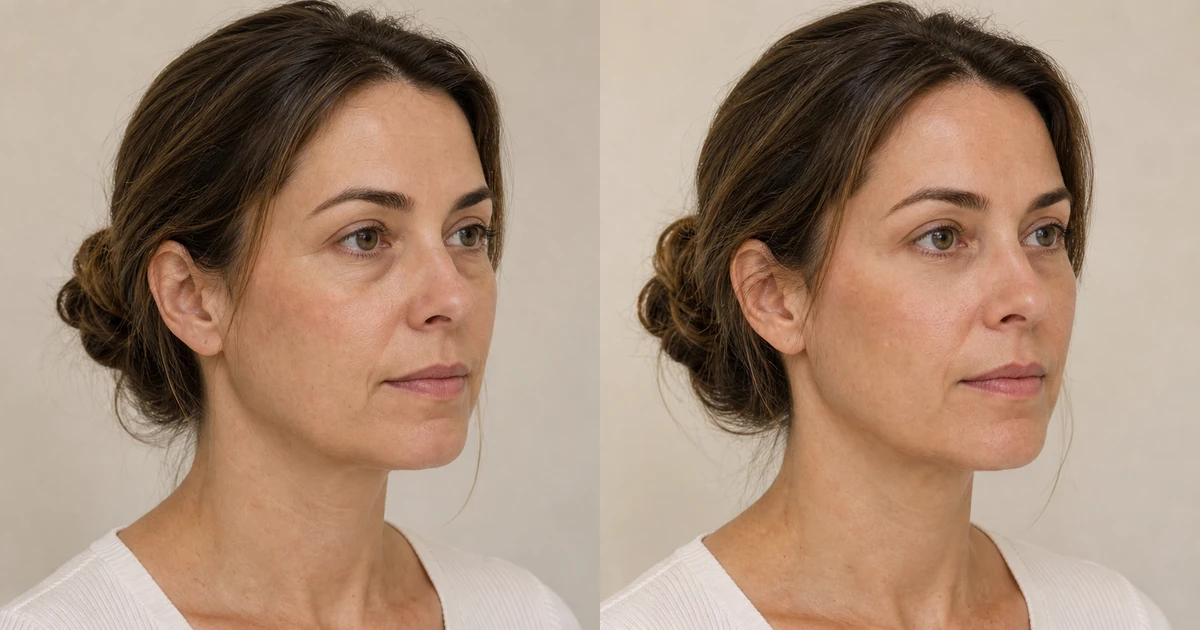
What Upper Eyelid Surgery Changes
According to NHS.uk guidance on eyelid surgery1, upper blepharoplasty removes excess skin — and sometimes a small strip of muscle or fat — from the upper eyelid. The change: less "hooded" appearance, eyes look more open, less "tired" impression. Scars sit within the natural lid crease and typically fade to near-invisibility over 12 months.
The "hooding" this operation addresses happens as the skin above the eye loses elasticity with age and gradually descends, sometimes to the point where it rests on the eyelashes and narrows the field of vision. During surgery, the surgeon marks the amount of skin to be removed while the patient is upright and the eyes are open, since lying down changes how the skin drapes — this marking step is one of the reasons results vary between surgeons, as too conservative a marking under-corrects and too aggressive a marking can make it difficult to close the eyes fully afterwards. The muscle layer beneath the skin (orbicularis oculi) and, in some patients, a small pad of fat are addressed at the same time if they are contributing to the heaviness, though many upper lid cases are skin-only.
Because the incision sits directly in the natural crease of the eyelid — the fold that forms when the eye is open — it is one of the best-camouflaged scars in facial surgery. Even in the first few weeks, when the line is pink and slightly raised, it is largely hidden when the eyes are open, which is one reason upper blepharoplasty patients often return to normal social activities faster than the visible bruising alone would suggest. By around 12 months most patients cannot find the scar at all without close inspection under bright light.
What Lower Eyelid Surgery Changes
Lower blepharoplasty targets fat bags below the eye — either by removing fat, or increasingly by repositioning it to smooth the transition from lid to cheek. Approaches:
- Transconjunctival — internal incision; no external scar; best for fat only.
- Transcutaneous — external incision below the lash line; allows skin removal when needed but carries a higher risk of lower-lid position change.
A Griffin et al. review of physical findings associated with postblepharoplasty lower eyelid retraction in Aesthetic Surgery Journal2 is worth reading regardless of which approach you're considering.
The choice between these two approaches is one of the most consequential decisions in lower eyelid surgery. Retraction (the lower lid pulling down slightly) and rounding at the corner are recognised risks of lower-lid surgery generally, and the Griffin review found several contributing factors worth understanding beforehand — orbicularis oculi muscle weakness, "negative-vector" anatomy (where the eye projects further forward than the cheekbone beneath it), midface volume deficiency, and lower-lid laxity, with middle-lamellar scarring a significant factor in only a minority of cases studied2. Many surgeons default to the transconjunctival approach wherever the main concern is fat rather than skin, partly because it avoids an external incision altogether, reserving the transcutaneous route for cases where skin laxity genuinely needs addressing, sometimes paired with a separate resurfacing step such as a laser or peel rather than more aggressive skin excision. If you are told you need a transcutaneous approach, it's reasonable to ask the surgeon directly about your own anatomical risk factors for retraction — including the ones above — rather than assuming the incision type alone determines the risk.
What It Does Not Fix
- Dark circles — most are pigment plus shadow from bone/soft-tissue structure; surgery reduces shadow but doesn't change pigment.
- Brow droop — a heavy brow can mimic upper-lid hooding; the answer is a brow lift, not blepharoplasty.
- Fine lines and crêpe skin — these are addressed with lasers or skin treatments, not excision.
- Ptosis (drooping lid margin) — a different anatomical problem that needs different surgery.
Distinguishing brow droop from upper-lid hooding is one of the most common sources of disappointing results, because the two conditions can look almost identical to the untrained eye but need entirely different operations. Brow droop happens above the eyebrow — the whole brow complex descends with age, pushing skin down onto the upper lid and creating a heavy, hooded appearance even though the eyelid skin itself may not be significantly excessive. If a surgeon removes eyelid skin in this situation, it can temporarily open the eye, but because the underlying cause — a low brow — hasn't been addressed, the heaviness tends to return, and removing too much lid skin to compensate risks leaving the patient unable to close their eyes fully. A simple test some surgeons use at consultation is gently lifting the brow with a finger: if that alone opens the eye and smooths the hooding, the answer is a brow lift, not blepharoplasty. Many patients need both, done either together or in sequence, and a thorough consultation should assess the brow position specifically rather than treating the eyelid in isolation.
Fine lines, crêpe-textured skin and pigmentation irregularities around the eyes are surface-level skin changes rather than problems of excess tissue, so cutting skin away does not resolve them — a blepharoplasty can leave crêpey-looking skin looking much the same in texture even though there is now less of it. These concerns are typically addressed separately with resurfacing treatments such as fractional lasers, chemical peels, or topical retinoid regimens, sometimes performed as a complementary treatment once the surgical healing is complete. Ptosis, meanwhile, is a mechanical problem with the muscle (levator) that holds the eyelid open, causing the lid margin itself to sit too low over the eye — this needs a ptosis repair, which tightens or reattaches that muscle, and is a fundamentally different operation from removing skin.
The Swelling Timeline Behind the Photos
- Days 1–3: peak bruising and swelling; cold packs.
- Week 1: sutures out; concealer usable.
- Weeks 2–4: most bruising gone; residual swelling.
- 3 months: scars faded and swelling settled — final result apparent.
This timeline matters enormously for interpreting photos because eyelid tissue is thin and swells visibly compared with most other areas of the face. In the first 48–72 hours, bruising can extend well below the lower lid and swelling can temporarily make the eyes look smaller or more asymmetric than either the pre-surgery baseline or the eventual result — a stage a patient understandably doesn't want photographed but which is exactly the stage a marketing gallery would never show either. By the end of the first week, most people feel comfortable in public with concealer, but subtle puffiness — particularly in the lower lid, where lymphatic drainage is slower — can persist for several weeks longer than the more dramatic bruising. Some residual firmness or mild lumpiness under the skin, especially with a transconjunctival approach, is normal for the first month or two.
The three-month mark is the point most surgeons use as the meaningful "after" photo, because it is when the eyelid tissue has generally regained its normal texture and any fine sutures have fully dissolved. Even so, subtle refinement can continue for up to six months in some patients, particularly around scar maturation and the very last trace of lower-lid firmness. Anyone comparing their two-week appearance to a clinic's polished 3-month "after" photo is, again, not comparing like with like.
Reading Photos Critically
Same operation, four looks:
- Angle: chin-up minimises upper-lid coverage; chin-down accentuates it.
- Lighting: flat overhead flatters; harsh sidelight exaggerates every hollow.
- Makeup: concealer transforms lower lids.
- Eye opening: a wider-eyed expression exaggerates the "opened up" impression.
Each of these variables can be manipulated, deliberately or not, to make an "after" photo look more dramatic than the actual surgical change. A patient photographed with their chin tilted slightly up in the "after" shot, but level or tilted down in the "before" shot, will appear to have far less upper-lid hooding than they actually do — this is one of the most common inconsistencies to check for in any gallery. Similarly, overhead studio lighting tends to soften shadows under the eyes and can make a lower-lid result look better than it would in ordinary daylight, while a single hard side light exaggerates every hollow and shadow, making an untreated "before" photo look deliberately worse.
Makeup is a particularly easy variable to overlook: a light layer of colour-correcting concealer can visually erase the exact under-eye shadow that blepharoplasty is meant to address, so an "after" photo taken with makeup applied tells you very little about the surgical result itself. Finally, genuine facial expression matters more than people expect — consciously or not, patients often widen their eyes slightly for an "after" photo, which lifts the upper lid margin and brow together and can make the surgical change look more pronounced than it will appear in a relaxed, neutral expression during everyday life. When you look at a gallery, try to mentally normalise for all four factors, or better, ask the clinic whether "before" and "after" images were taken under matched, standardised conditions — many reputable practices now do this specifically to avoid misleading comparisons.
How Long Results Last
Upper blepharoplasty typically holds a decade or more — skin will continue to age, but a repeat is rarely needed early. Lower blepharoplasty tends to be more permanent because fat repositioning doesn't regrow. BAAPS's eyelid surgery (blepharoplasty) patient information3 covers realistic expectations and recovery in more detail if you want the fuller picture before consulting.
The reason upper and lower blepharoplasty age differently comes down to what each operation actually removes. Upper lid surgery excises a fixed amount of excess skin, but the surrounding skin continues to age and lose elasticity at its normal rate afterwards, so some patients notice mild recurrence of hooding after ten to fifteen years — though rarely to the same degree as before the original surgery, since a portion of the stretched skin is permanently gone. Lower lid surgery, particularly when it addresses fat via a transconjunctival approach, tends to be more stable over time because the fat pads that caused the bagginess have been directly reduced or repositioned and don't return in the way skin continues to loosen. Lifestyle factors — sun exposure, smoking, and significant weight fluctuation — can accelerate skin-related changes around the eyes regardless of which procedure was performed, so protecting the results with sunscreen and stable weight is a reasonable long-term habit for anyone who has had eyelid surgery.
FAQ
Does blepharoplasty fix dark circles?
No. Blepharoplasty (eyelid surgery) removes excess skin or repositions fat, which can soften the shadow that contributes to a dark-circle appearance, but it does not change skin pigmentation itself. Genuine pigment-based dark circles need separate treatments such as topical brighteners, chemical peels, or laser therapy, not eyelid surgery.
When are final results visible?
Most bruising and swelling from blepharoplasty resolve within two to four weeks, but the true final result is usually only visible around three months, once residual swelling has fully settled and scars have started to mature. Photos taken earlier than that show a healing eyelid, not the finished outcome.
Upper or lower — which do I need?
Upper blepharoplasty suits hooded, heavy upper eyelids that make the eyes look tired or partly closed. Lower blepharoplasty suits under-eye fat bags. Some patients need both together for a balanced result. If the real issue is a low brow rather than the eyelid itself, a brow lift is the appropriate procedure instead.