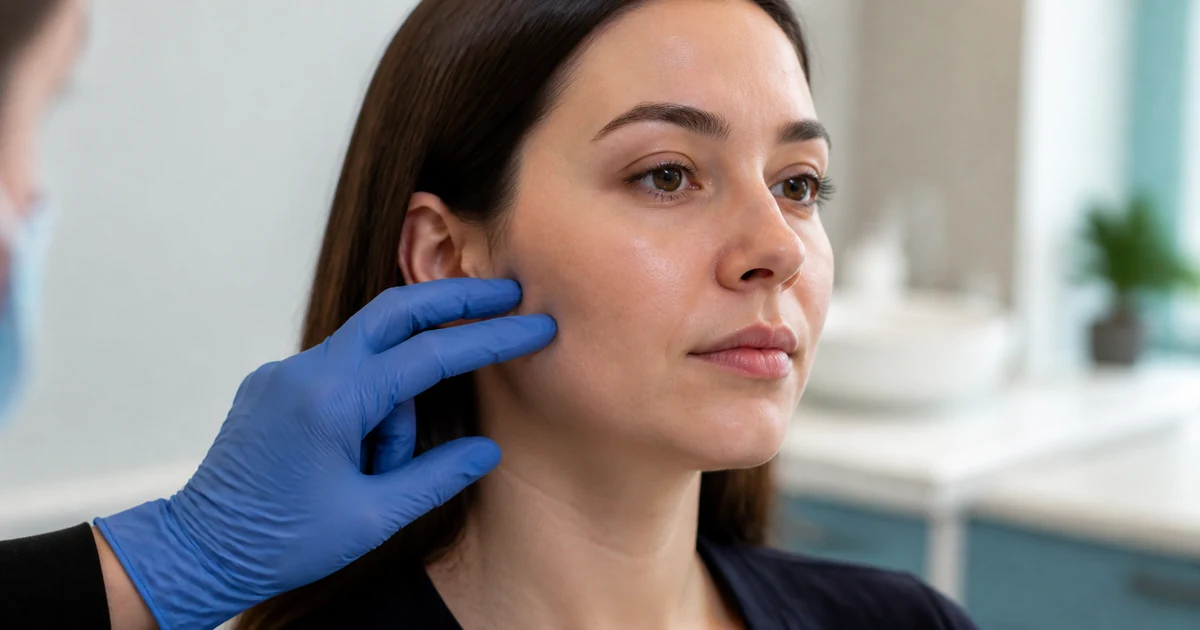
What the Buccal Fat Pad Is
The buccal fat pad (also called Bichat's fat pad) sits deep in the cheek, wedged between the muscles of mastication rather than just under the skin like ordinary subcutaneous fat. It has a genuine structural function in infancy — thought to assist suckling and cushion the chewing muscles — and it stays with us into adulthood, where it contributes meaningfully to lower mid-face fullness and the smooth transition between cheek and jawline that many faces have in youth. A clinical review of buccal fat pad excision for cheek refinement2, covering four studies and 134 procedures, found a favourable short-term aesthetic outcome and a low complication rate, while explicitly noting a lack of long-term follow-up data. The change is generally considered permanent because the discrete anatomical pad does not regenerate once removed, though robust long-term (multi-decade) outcome data is limited.
It's worth being clear about what the pad is not: it isn't the same as the subcutaneous fat that responds to weight loss and gain, and it isn't the same fat compartment addressed by facial liposuction, which works closer to the skin surface. This distinction matters because it explains why diet and exercise have no effect on buccal fullness, and why the procedure's effect is specific to the lower cheek rather than the face generally.
What the Procedure Does
Through a small incision inside the mouth, opposite the second upper molar, the surgeon accesses and removes a controlled portion of the pad — usually a few grammes per side, judged intraoperatively against the desired result rather than a fixed universal amount. There is no external scar, since the entire procedure is performed through the mouth. The effect is specific to the lower cheek and mid-face contour, softening a rounded lower-cheek profile and, in some faces, subtly enhancing the appearance of the cheekbone above by removing the fullness beneath it. It does not change the jawline or lower face structurally, and it has no effect on the upper cheek or under-eye area — patients hoping to address jowls or a heavy jawline with this procedure alone are usually looking for the wrong operation; see Alternatives, below.
Who Is (and Isn't) a Good Candidate — Face Shape & Age
Best candidates have a genuinely round or "chubby" lower cheek that persists consistently at a stable, healthy weight — in other words, the fullness isn't simply reflecting a currently higher body weight that's likely to change. People with a naturally slimmer face, or younger patients who are still likely to lose some residual "baby fat" as their face matures into their mid-twenties, are typically counselled against it, or at minimum advised to wait. Facial ageing brings natural volume loss across the whole face over time; buccal fat removal amplifies that future loss specifically in the lower cheek, which is the central trade-off every candidate needs to understand before consenting — see How It Ages, below.
General Health and Realistic Expectations
Candidates should be in good general health, non-smokers or willing to stop smoking for a defined period around surgery to support healing, and should have realistic expectations about a subtle, specific change rather than a dramatic facial transformation. A responsible surgeon will decline or defer patients whose face shape doesn't clearly show a genuine buccal fat pad contribution to their cheek fullness, since the risk in these borderline cases is a face that looks hollow rather than refined.
The Procedure & Anaesthetic
Buccal fat removal can be performed under local anaesthetic with light sedation, or under a light general anaesthetic, and is typically a day case lasting 30–60 minutes for both sides combined. The choice of anaesthetic is often a matter of surgeon preference and patient comfort rather than clinical necessity for most straightforward cases, though a general anaesthetic may be preferred where the procedure is combined with something else, such as chin or jaw contouring, in the same session.
Step by Step
After anaesthetic, the surgeon makes a small incision inside the cheek, opposite the upper second molar, and gently teases out a portion of the underlying fat pad through gentle pressure and blunt dissection, taking care to stay well clear of the parotid (Stensen's) duct and the buccal branch of the facial nerve that run nearby. A judged amount is removed and the effect assessed visually before the incision is closed with a small number of dissolvable sutures. Because the whole procedure happens inside the mouth, there is no visible external scar at any stage.
Combining With Other Procedures
Buccal fat removal is sometimes performed alongside chin augmentation, jawline contouring or a facelift, where removing lower-cheek fullness helps the surgeon achieve a more defined lower-face result overall. Combining procedures adds theatre time and should be reflected in a specific combined quote — see Buccal Fat Removal Cost for how this is typically priced.
Is It Permanent? How It Ages Over 10+ Years
The Fat Pad Doesn't Grow Back
The pad is a discrete anatomical structure with a defined boundary, not a diffuse layer of fat. Once partially removed it does not regenerate, in the same way that removing part of an organ doesn't allow it to regrow. Weight gain afterwards can add ordinary subcutaneous fat overlying the area, which can partially soften or mask the change in the short-to-medium term, but the buccal pad itself is permanently smaller.
Natural Facial Volume Loss With Age
Rohrich and colleagues, in Plastic and Reconstructive Surgery3, describe how individual facial fat compartments age differently rather than uniformly — some deflate and lose volume while others can enlarge or descend — as part of the normal ageing process that affects everyone regardless of any cosmetic procedure; the compartments in the mid-face, including the area affected by buccal fat removal, are among those that typically lose volume over time. A patient who has a meaningful proportion of their buccal fat removed at 25 enters that natural volume-loss curve from a lower baseline than they would otherwise have had — the two effects (natural ageing loss, plus surgical removal) are additive, not separate.
Why Surgeons Are Cautious With Young, Thin Patients
Reputable surgeons often decline younger and slimmer patients specifically because of this trajectory, even when the patient is requesting the procedure enthusiastically and it is currently trending on social media. A surgeon willing to say no to a technically straightforward, profitable procedure on long-term-safety grounds is a meaningfully positive sign, not an inconvenience — see Red Flags for other situations where hesitation from a surgeon should be reassuring rather than frustrating.
What Evidence Shows vs What's Speculation
Long-term (20+ year) outcome studies specifically following cosmetic buccal fat removal patients into later middle age are sparse in the published literature. Public statements about "looking gaunt at 45" are typically a reasonable extrapolation from two things we do have solid evidence for — normal age-related facial fat loss, and the anatomy of what's permanently removed — rather than a finding from a formal long-term clinical trial. This is informed clinical judgement, and it's honestly presented as such; ask your surgeon directly how they weigh this uncertainty for a face like yours specifically, rather than accepting a blanket reassurance either way.
Risks & What "Gone Wrong" Means
- Asymmetry — from unequal removal between the two sides; a genuinely common cosmetic complaint, and one reason surgeon experience and a conservative, assess-as-you-go technique both matter.
- Over-resection — removing too much, giving a gaunt, prematurely aged look that cannot be corrected by the same operation; the single most consequential risk given the change is permanent.
- Buccal branch of facial nerve injury — rare but real; this nerve controls part of smile movement, and injury can cause temporary or, rarely, permanent asymmetry when smiling.
- Salivary duct injury — Stensen's duct, which carries saliva from the parotid gland into the mouth, runs close to the surgical field and can rarely be injured.
- Infection or haematoma — uncommon, given the procedure is performed through the naturally bacteria-rich environment of the mouth, which is why a course of antibiotics and saltwater rinses are typically prescribed.
- Persistent numbness — of the cheek or surrounding area, usually temporary as minor nerve endings recover.
- Dissatisfaction with a subtle result — because the change is deliberately modest in well-selected patients, some find the difference less dramatic than social media portrayals suggest.
Recovery
Most patients return to work within a week, sooner for a desk-based role. The recovery pattern has one counter-intuitive feature worth knowing in advance: swelling in the first 2–4 weeks can make the cheeks look temporarily fuller than your starting point, which understandably worries some patients into thinking the procedure hasn't worked — it has, the swelling is simply masking it. The true, reduced contour becomes visible as swelling subsides over 2–3 months, with subtle final settling continuing for a little longer in some patients. The mouth needs particular care during healing: soft food for the first few days, avoiding hot or spicy food that irritates the incision sites, and regular saltwater rinses after eating to keep the small internal incisions clean while they heal.
If You Regret It: Fat Transfer and Its Limits
Fat transfer (autologous fat grafting, using your own fat harvested from elsewhere on the body) can add subcutaneous volume back to the mid-face and soften an over-hollowed appearance, and it's the main option available to patients who feel too much was removed or who simply age into wanting more volume back later. It genuinely helps in many cases — but it adds volume in a different tissue plane, closer to the skin, and does not recreate the deep, distinct buccal pad in its original anatomical position. The honest framing is some volume, some contour improvement, not a full reversal to the pre-surgery state.
Alternatives to Consider First
- Weight stabilisation at a healthy point first — some perceived cheek "chubbiness" changes meaningfully with weight and doesn't need a permanent surgical answer.
- Contouring with makeup for a reversible, no-commitment way to see how a slimmer lower cheek might look before considering anything permanent.
- For jawline contour specifically, a chin or jaw evaluation may be the more relevant procedure, since buccal fat removal does not touch the jawline itself.
- Waiting, if you're under around 25 — facial maturation is often still completing, and the trade-off described in How It Ages is more favourable to assess once your face has settled into its adult shape.
Cost in the UK
Typically £2,500–£4,500, including the surgeon's fee, the anaesthetist's fee where sedation or general anaesthetic is used, and the facility fee. Buccal fat removal is a cosmetic procedure and is not routinely available on the NHS — see NHS.uk's overview of cosmetic procedures1 for the general funding picture — and there is no functional variant of this operation that might occasionally qualify, unlike some other procedures on this site. A fair quote should itemise each component separately along with a defined number of follow-up appointments and a written revision policy — particularly important given the change is irreversible. See the full breakdown in Buccal Fat Removal Cost.
Choosing a Surgeon
Check the GMC Specialist Register before booking — "cosmetic surgeon" is not a protected title in the UK, so GMC registration and Specialist Register entry is the most useful single verification step available to any patient. Because this is a permanent, irreversible facial change with a genuine long-term-ageing trade-off, ask specifically about the surgeon's own experience with facial contouring and buccal fat removal in particular, ask to see results in patients photographed years — not weeks — after surgery where possible, and ask directly how they decide how much to remove.
FAQ
Is buccal fat removal permanent?
Yes. The buccal fat pad is a discrete anatomical structure that does not regenerate once part of it is removed, which is why the decision deserves an unhurried consultation rather than a quick booking.
Will it make me look older later?
Faces lose volume naturally with age. Removing part of the buccal fat pad starts you from a lower baseline; whether that becomes visibly gaunt depends on starting face shape, weight trajectory and how much was removed. Reputable surgeons take a conservative view in young, slim patients.
Can it be reversed?
Not fully. Fat transfer can restore some subcutaneous volume in the same general area, but does not replace the anatomical pad in its original position.
What age is too young for it?
Most UK surgeons prefer patients in their late 20s or older, at a stable weight. Facial maturation, including natural loss of residual cheek fullness, continues into the mid-twenties for many people.
Does it hurt, and what's recovery like day to day?
Most patients describe manageable discomfort rather than severe pain, controlled with standard analgesia. Soft food and saltwater rinses are needed for the first few days, and most people return to a desk-based job within a week.
Can it be combined with other facial procedures?
Yes — it's commonly combined with chin augmentation, jawline contouring or a facelift, where removing lower-cheek fullness supports a more defined overall result. Ask for a specific combined quote rather than assuming prices simply add together.