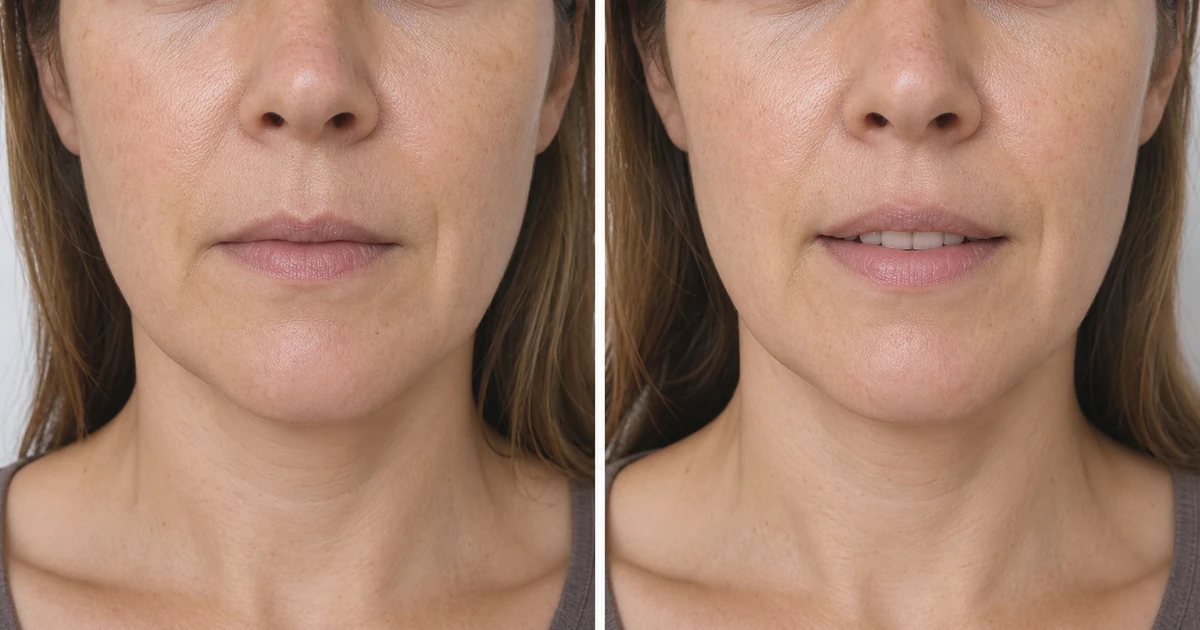
What a Lip Lift Does
The bullhorn (subnasal) lip lift removes a strip of skin just below the base of the nose, in the shape of a wide, shallow arc that echoes the natural curve of the nostril sills — which is where the "bullhorn" name comes from. Closing that gap physically shortens the philtrum, the vertical stretch of skin between the base of the nose and the top of the upper lip, and advances the lip itself upward. It is a structural change to the position of the upper lip, not a volume increase.
The practical effect is threefold: more red lip (vermilion) is visible at rest, more of the upper teeth show when the mouth is relaxed rather than only when smiling, and the ratio between the upper and lower lip shifts toward what many people read as a more youthful proportion. This is a meaningfully different goal from adding fullness to the lip itself — a lip lift does not make the lip bigger so much as it reveals more of the lip that was already there, by shortening the skin above it. Some techniques also allow subtle adjustment of the "cupid's bow", the double curve at the centre of the upper lip border, though this is a secondary refinement rather than the main purpose of the operation.
It is worth being clear that this is a millimetre-level procedure. A typical lip lift shortens the philtrum by two to four millimetres1 — a change that is easy to miss in a casual glance but reads clearly in side-by-side photographs, because the upper lip and the visible tooth show at rest are both features the eye is naturally tuned to notice on a face.
There are variations on the basic technique — for example, an "Italian" lip lift that places the incision differently to preserve more of the natural philtrum column, or a central lift that only shortens the middle portion rather than the full width of the lip — and the choice between them depends on the individual's anatomy and the surgeon's preferred approach. What matters most for a prospective patient is not memorising every named variant but understanding the shared goal: all of them shorten the visible skin above the lip and expose more of the lip itself, rather than adding volume. A useful question to bring to consultation is simply how many millimetres of change the surgeon expects, and whether the plan is a full bullhorn excision or one of the more limited variants — the answer says a lot about how conservative or aggressive the surgeon's typical approach is.
Lip Lift vs Lip Filler
Filler and a surgical lift work in fundamentally different ways:
- Lip filler: hyaluronic-acid volume added to the lip; temporary (6–12 months); reversible with hyaluronidase.
- Lip lift: surgery; changes the shape and position of the lip; permanent; not reversible without further surgery.
The confusion between the two is understandable because both can leave a fuller-looking upper lip, but they get there by entirely different mechanisms. Filler adds volume inside the lip tissue itself, plumping it outward; a lift does not add any volume at all — it simply repositions the existing lip higher by removing skin above it, so more of the lip that was always there becomes visible. This is also why the two are not interchangeable substitutes: someone with a long philtrum but a naturally full lip may be a poor filler candidate (more volume on an already-full lip can look overdone) but a good lift candidate, while someone with a short philtrum and a genuinely thin lip may benefit more from filler, or from both together. Many surgeons do, in fact, combine a conservative lip lift with a small amount of filler, using the surgery to correct the underlying proportion and the filler to fine-tune volume — this is not a contradiction of the "structural vs temporary" distinction, just a recognition that the two techniques solve different parts of the same aesthetic goal.
Downtime and commitment also differ substantially. Filler is typically a same-day injection with little to no visible recovery beyond brief swelling, which is part of why it is often used as a first, low-risk step for someone curious about a fuller-looking upper lip. A lip lift is a surgical procedure carried out under local or general anaesthetic, with visible swelling and a healing scar for the first couple of weeks and full settling over several months, but it never needs repeating the way filler does every six to twelve months to maintain the effect. Someone who has relied on repeat filler appointments for years, and who is tired of the recurring cost and maintenance, is often the profile of patient who eventually asks about a lift as a one-time alternative — though the two are not simply interchangeable, since a lift cannot replicate pure volume the way filler can.
The Scar: Where It Sits and How It Heals
The scar follows the natural crease where the base of the nose meets the upper lip, running along the nostril sills — a location chosen specifically because it sits inside an existing shadow line on the face, rather than across smooth skin where a scar would be more exposed. In most patients it fades to a hair-line pale mark that other people wouldn't notice unless looking closely, usually within six to twelve months as the redness settles and the scar matures. In some — particularly those with a tendency to keloid or hypertrophic scarring, or darker skin tones that are more prone to visible pigment change at a healed incision — it remains more noticeable, and this should be discussed candidly at consultation rather than assumed away.
Healing follows a fairly predictable path: swelling and some tightness in the first one to two weeks, sutures removed (or dissolving on their own) around day seven to ten, a pink or red scar line for several weeks after that, and gradual fading over the following months. Sun exposure on an unhealed or immature scar can darken it permanently, so surgeons generally advise sun protection over the area for the first year. Realistic before/after photos should show the scar at the six-to-twelve-month mark, in natural daylight rather than flattering studio lighting, since that is the point at which the true, settled appearance becomes apparent — early photos taken at two or three weeks will always show a more obvious mark than the eventual result.
Candidacy
- Long philtrum (subjectively — but generally >18–20 mm at rest).
- Thin upper lip that has thinned with age.
- Non-smokers (smokers heal worse and scars are more visible).
- Realistic expectations — this is a millimetre-level change, not a lip transformation.
Philtrum length naturally increases with age as the skin above the lip loses elasticity and gradually lengthens and flattens — this is part of why a fuller, shorter-looking upper lip reads as more youthful, and why many candidates are seeking to reverse an age-related change rather than alter something they were born with. That said, some people are simply born with a longer philtrum relative to the rest of their face and consider a lift for that reason alone, independent of age.
Good candidacy is also about tissue quality, not just measurements: skin that stretches easily and heals with minimal scarring gives a more predictable result than skin that is thick, oily or scar-prone. A thorough consultation should include a physical measurement of philtrum length, an assessment of how much upper tooth already shows at rest and when smiling, and an honest conversation about scarring risk based on skin type and personal or family history of raised scars.
Risks & Over-Correction
Over-correction leaves too little skin between nose and lip, exposing too much upper tooth at rest and giving an unnatural "teeth-out" or strained look, sometimes described as a permanently "smiling" mouth even at rest — this is generally considered the more disfiguring of the two failure modes because it is harder to correct later. Under-correction, by contrast, gives an underwhelming result that may simply mean the surgery didn't achieve enough change to justify itself, but it is easier to revise with a second, more aggressive lift if needed. Both are common regret points raised by patients researching the procedure.
Numbness and altered sensation of the upper lip is common in the first weeks after surgery and usually improves steadily over three to six months as the small sensory nerves in the area recover; permanent alteration is uncommon but not impossible. Asymmetry of the scar or of the amount of lip show on each side can also occur, particularly if swelling resolves unevenly, though most mild asymmetry settles as healing completes. Beyond these specific concerns, a lip lift carries the same general surgical risks as any cosmetic operation — bleeding, infection, scarring, an anaesthetic reaction — as a general principle set out in broad terms by NHS.uk's overview of cosmetic procedures2. Choosing a surgeon experienced specifically in lip lifts, rather than one who performs the procedure only occasionally, is one of the more meaningful ways to reduce the chance of over- or under-correction, since judging the right amount of skin to remove is a matter of experienced eye as much as measurement. Checking that a surgeon holds the voluntary Royal College of Surgeons of England cosmetic surgery certification3 is a further, assessed way to check relevant training before booking a lip lift.
Longevity
Permanent. The skin removed does not regrow, so the shortened philtrum and the increased lip show it creates do not reverse themselves over time the way a filler result fades. Faces continue to age around the change, however — the surrounding skin, the corners of the mouth, and the lower face will keep changing with the years, which means a lip lift performed in one's thirties will still sit within an older-looking face decades later, even though the specific proportion it corrected remains stable — a pattern borne out by long-term follow-up showing the measured lip show is well maintained but eases slightly over five-plus years as the surrounding tissue keeps ageing4. Weight change, further ageing of the surrounding tissue and, rarely, revision surgery for scarring are the main things that can alter the appearance of the result long after the original healing period is complete.
FAQ
Does a lip lift leave a visible scar?
Yes — every lip lift leaves a permanent scar at the base of the nose, along the nostril sills. In most people it fades within six to twelve months to a hair-line pale mark that isn't noticeable in normal conversation or lighting, though it remains more visible in those prone to raised or pigmented scarring.
Lip lift or filler?
They solve different problems. Lip filler is a temporary, reversible injection that adds volume to the lip for six to twelve months. A lip lift is permanent surgery that repositions the lip higher by shortening the philtrum. Some patients benefit from combining a conservative lift with a small amount of filler.
Is it permanent?
Yes. The strip of skin removed during a lip lift does not grow back, so the shortened philtrum and the extra upper-lip show it creates are permanent. The surrounding face will still continue to age normally afterward, but the specific proportion the surgery corrected does not reverse on its own.