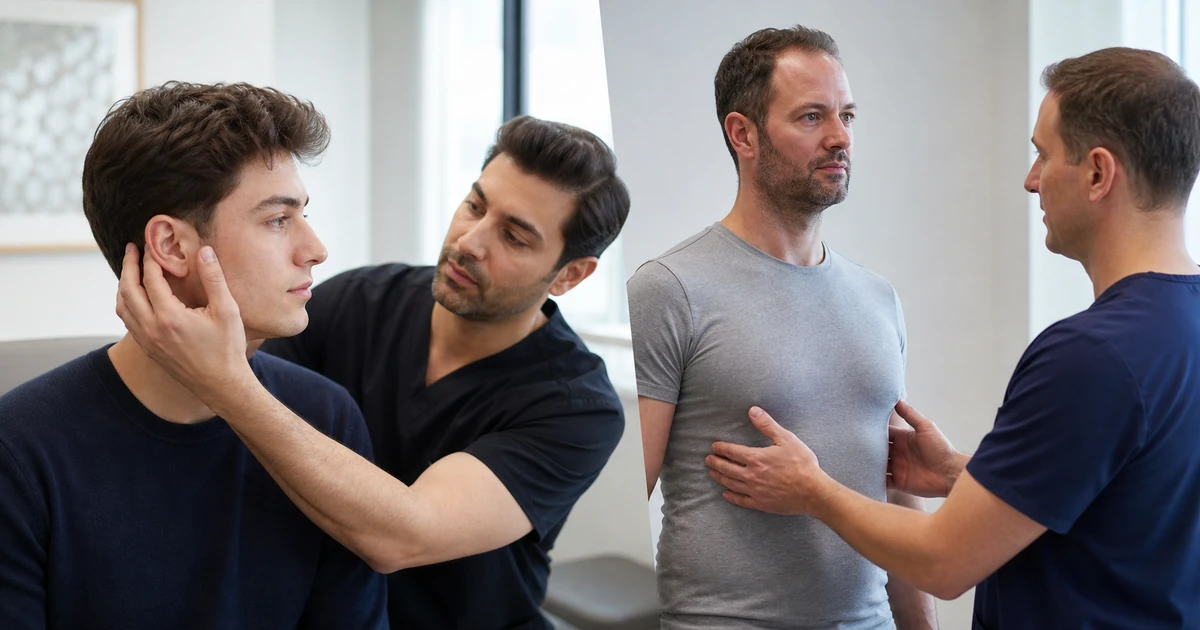
Otoplasty — What Changes
According to NHS.uk on ear correction1, otoplasty pins prominent ears closer to the head and, when needed, defines or re-creates the antihelix fold (the inner curve of cartilage that's often flattened or absent in prominent ears). The surgeon works through an incision behind the ear, folding or scoring the cartilage and securing it with permanent internal stitches so it holds its new shape as it heals. Scars sit behind the ear, hidden in the natural crease where the ear meets the scalp, and are not visible from the front once healed.
The degree of change achievable depends on the underlying cause of the prominence — whether it's a poorly formed antihelix fold, an overly large concha (the bowl-shaped part of the ear), or a combination of both — and a good surgeon will assess this individually rather than applying one technique to every ear. The aim is symmetry and a natural-looking angle relative to the head, not identical ears, since almost everyone has some natural asymmetry between their left and right ear even before any surgery.
Results in Children vs Adults
Ear growth is largely complete by around age 5, which is why surgery is generally not considered younger — operating before the ear has finished growing risks a less predictable long-term shape. Results in both age groups are technically similar, since the surgical technique doesn't change much with age; the main differences are practical. Children tend to heal quickly and have more elastic cartilage that holds a correction well, but their emotional readiness for surgery, ability to tolerate the healing process, and understanding of what's being done varies enormously between individual children and needs careful assessment, not just an age cutoff. Adults, by contrast, are better able to weigh the decision themselves but may have stiffer cartilage that's technically more challenging to reshape.
Relapse and Asymmetry
Cartilage has memory — it tends to want to spring back toward its original shape, which is why the permanent stitches placed during surgery matter so much to the durability of the result. Some relapse toward the original position can occur, usually in the first year, and is more likely with weaker cartilage or techniques that rely on stitches alone rather than also reshaping the cartilage itself. Small asymmetries between the two sides are common and expected, partly because most people start with some natural asymmetry and partly because healing rarely progresses at exactly the same rate on both sides. Realistic before-and-after photos show these — a slightly different angle or fold shape between left and right — at 6–12 months, and a surgeon who claims perfect symmetry in every case is not being fully candid.
The Child's Own Wish Matters
UK ethical guidance is clear that in children's cosmetic surgery, the child's own understanding and wish is required — not just parental preference. This is a genuine, actively assessed criterion, not a formality: a surgeon following good practice will want to talk with the child directly, in age-appropriate terms, about what bothers them, what they expect surgery to change, and whether they're asking for this for themselves rather than to satisfy a parent's discomfort with how their ears look. Children who have surgery reluctantly, or primarily because a parent pushed for it, report worse satisfaction and psychological outcomes than children who wanted the change themselves and understood what was involved.
In practice this means the consultation process for a child is different from an adult one. Surgeons and clinical teams typically want to see that the child can articulate, in their own words, what they'd like to be different and why — often prompted by teasing or self-consciousness the child has raised themselves, rather than a concern the parent noticed first. Parents play an essential role in arranging the consultation, asking practical questions, and providing consent, but the decision to proceed should reflect the child's own wish being heard and taken seriously, not overridden or substituted by what a parent thinks is best. If a child seems ambivalent, uncertain, or is only agreeing to please a parent, that is a reasonable basis to pause or delay, since the psychological research consistently favours the child driving the choice.
Gynaecomastia Surgery — What Changes
Gynaecomastia — enlargement of male breast tissue — is a common and entirely normal medical condition, not a personal failing or something to be embarrassed about; it affects a substantial proportion of men at some point in their lives, often around puberty or later in life, frequently linked to hormonal shifts, certain medications, or weight changes, and sometimes with no identifiable single cause. Surgery removes the excess glandular tissue behind the nipple and, usually, surrounding fat via liposuction or direct excision. The chest contour flattens as a result, and the nipple-areola complex tends to sit more naturally against a flatter chest wall rather than appearing to project forward on a mound of tissue.
Skin quality is the single biggest variable in how good the final contour looks. Taut, elastic skin — more typical in younger patients or those with a shorter history of the condition — retracts smoothly over the newly flattened chest without needing to be trimmed. Loose skin, which is more likely after significant weight loss or in older patients with longstanding gynaecomastia, may not retract on its own and can require additional skin excision to avoid a loose or draped appearance — a larger operation with more extensive scarring, but often still the better choice cosmetically than leaving excess skin in place.
Why Results Depend on Skin Quality
The Braunstein clinical review in the NEJM2 is a good general clinical overview of gynaecomastia and its causes and management, though — as an endocrine-focused review rather than a surgical-technique paper — it isn't the source for the surgical-contouring detail that follows, which reflects general plastic-surgery experience instead. In brief: young men with recent-onset gynaecomastia and good elastic skin tend to get the smoothest, most predictable contours, because their skin can shrink down evenly over the flatter chest. Older men, those with longstanding gynaecomastia that has stretched the skin over years, and patients who have lost a large amount of weight may need more extensive surgery combining tissue removal with skin excision to achieve a comparably flat, well-contoured result — this isn't a reflection of the surgery being less successful, simply that there's more work for the skin envelope to do in those cases.
Scarring Around the Areola
Where only glandular tissue and fat need removing, the excision incision runs along the lower half of the areola border, following the natural colour change between areola and surrounding skin; scars here are typically inconspicuous once fully healed, often barely visible even up close. Where skin excision is needed because the skin can't retract on its own, scars extend beyond the areola — sometimes as a horizontal line across the chest or an anchor-type pattern — and remain more visible than a periareolar-only scar, though they still fade and flatten over the first year in the same way any surgical scar does.
Reading Result Photos in Both
- Pose: arm position changes the apparent chest contour substantially in gynaecomastia photos — arms raised stretch and flatten the chest, arms relaxed at the sides can reveal residual fullness that a raised-arm photo hides.
- Lighting: harsh sidelight exaggerates every contour and shadow on the chest, and can make ear position or cartilage folds look sharper or more pronounced than they appear in normal room lighting.
- Swelling stage: both operations swell for weeks — otoplasty around the ear and scalp, gynaecomastia across the chest and sometimes down toward the abdomen if liposuction was extensive — so an early photo will look tighter or more dramatic than the settled result.
- Camera angle for ears: a photo taken from directly behind exaggerates how much the ears stick out compared with a more natural three-quarter or front view; ask to see both.
- Compression garment marks: temporary indentation lines from a compression vest can be mistaken for scarring or asymmetry in early gynaecomastia photos — these fade within days of removing the garment and aren't part of the permanent result.
As with any before-and-after gallery, ask when each photo was taken relative to surgery, and be cautious of gallery pairs that don't state a timeframe at all. A trustworthy set of photos for either procedure will typically include images from at least 6 months, and ideally a year, since both operations continue to refine subtly well beyond the first few weeks.
Recovery Timelines
Supportive garments and dressings in the weeks after either operation are what protect the new position or contour while swelling resolves and tissues settle into their healed state:
- Otoplasty: BAAPS patient information on setting back prominent ears3 advises wearing a protective headband or bandage at night to stop the ears being bent forward against the pillow while healing; the exact duration is individually advised by the surgeon and commonly continues for some weeks. Most people return to school or non-contact work at around 1 week, though contact sports and activities risking a direct blow to the ear are usually restricted for several weeks longer.
- Gynaecomastia: BAAPS patient information on male chest reduction3 advises wearing an elastic pressure garment continuously for one to two weeks to help control swelling, sometimes continued longer at the surgeon's discretion, before easing into normal clothing. Most patients return to office-based work at around 1 week, with heavier lifting and gym training — particularly chest exercises — usually delayed until around 6 weeks once initial healing is well established.
For both procedures, the visible swelling in the first 1–2 weeks tends to overstate the eventual change, and it's normal for the area to still feel firm or mildly tender to pressure for a couple of months after the garment stage ends. Following the surgeon's specific instructions on garment wear, activity restriction and follow-up appointments has a real effect on the smoothness of the final contour — skipping garment wear or returning to strenuous activity early is one of the more avoidable causes of a less-than-optimal result.
FAQ
Do ears move back over time?
Small relapse can occur; complete return to prominent position is rare with modern technique.
Will gynaecomastia come back?
Removed glandular tissue doesn't regrow. New tissue can form if the original cause (steroids, medication) is still present.
How visible are the scars?
Both usually inconspicuous. Gynaecomastia scars extend where skin excision is needed.