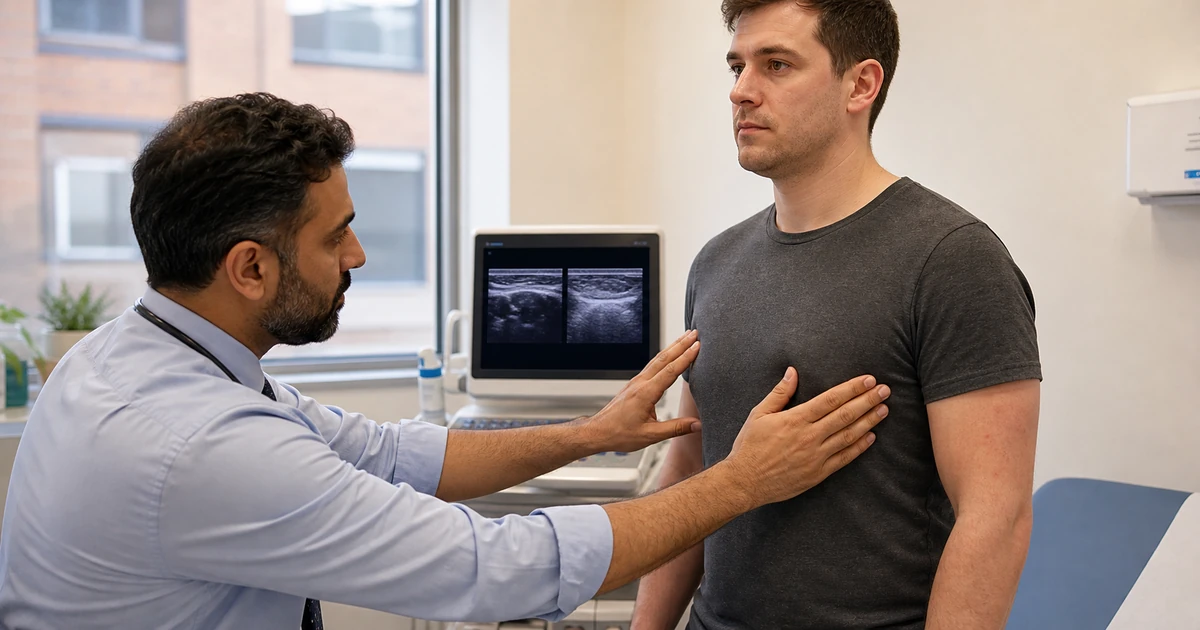
The Core Difference
The two conditions are often confused because they can look similar in a t-shirt, but they are physically different tissues that respond to completely different treatments. Telling them apart correctly, before deciding on any course of action, is the single most important step in this whole guide.
- Gynaecomastia: real glandular breast tissue behind the nipple. Feels firm and disc-like on examination, usually centred directly under the areola. Does not respond to weight loss or exercise, no matter how disciplined the diet or training programme.
- Pseudogynaecomastia (chest fat): subcutaneous fat distributed over the pectoral area, similar to fat anywhere else on the body. Soft, diffuse, without a distinct firm centre. Responds to weight loss and lean-mass gain in the same way fat elsewhere does.
- Mixed: most adult cases have components of both — some genuine glandular tissue sitting within a broader layer of chest fat, which is part of why self-diagnosis from appearance alone is unreliable.
Gynaecomastia is common rather than rare, affecting a substantial proportion of men at some point in their lives — most often around puberty and again in later adulthood as hormone levels shift with age. It is not a sign of poor fitness or a failure of self-discipline, and men presenting with it should not expect, or be given, a judgemental tone from a GP or surgeon. The distinction between gland and fat is a clinical question, not a verdict on lifestyle.
How Doctors Distinguish Them
According to Braunstein GD's clinical practice review of gynecomastia in the New England Journal of Medicine1, the clinical examination is straightforward for an experienced clinician: palpation of a firm, mobile, disc-shaped mass centred under the nipple, versus soft, diffuse fat that blends into the surrounding chest wall without a clear edge. The patient usually lies flat with the examiner gently pinching the tissue directly behind the areola between finger and thumb — a true glandular disc is distinctly firmer than the fat around it.
In borderline cases, or where the examination is inconclusive because of a higher overall body fat percentage, imaging — usually ultrasound, occasionally mammography — may be used to characterise the tissue more precisely. In a small number of cases where there are red flags — a unilateral, hard, non-mobile mass, nipple discharge, skin dimpling, or rapid recent growth — further investigation is needed specifically to exclude other, rarer causes, including male breast cancer, which though uncommon should never be assumed away without examination.
When ultrasound is used, it typically distinguishes three patterns: a discrete, well-defined glandular nodule (typical uncomplicated gynaecomastia), a more diffuse fibroglandular pattern (often seen in longer-standing or medication-related cases), and simple fatty tissue with no distinct glandular component (pseudogynaecomastia). This imaging step is quick, non-invasive and widely available, and it's a reasonable thing to ask for if an examination alone leaves genuine doubt about which tissue is present, particularly in patients with a higher overall body fat percentage where palpation is less reliable.
Why It Changes Treatment
Chest Fat — Weight Loss Can Help
Pseudogynaecomastia responds — sometimes fully — to overall fat loss and pectoral training, because it is simply fat distributed in a particular area. A sustained calorie deficit combined with resistance training aimed at the chest is a reasonable first approach for a patient whose examination points to fat rather than gland, and it costs nothing beyond the time invested. Surgery, if desired once a stable weight is reached, is liposuction alone, since there is no glandular disc to excise.
True Gynaecomastia — Diet Won't Remove Glandular Tissue
You can be at an ideal, healthy weight and still have clearly visible gynaecomastia, because the glandular tissue driving the appearance is not fat and does not shrink with calorie restriction or exercise. This is precisely why patients are sometimes frustrated after months of disciplined dieting with no change to their chest — they were treating the wrong tissue. Surgery for true gynaecomastia involves direct excision of the glandular disc, usually via a small incision at the areolar edge chosen to keep the resulting scar as inconspicuous as possible.
Mixed Cases
Most adult cases combine both components in varying proportions, which is why a single generic "gynaecomastia surgery" description doesn't tell you much about what your own operation would actually involve. The operation typically combines liposuction to remove the surrounding fat with direct excision of the glandular disc, planned together so the chest contours evenly rather than leaving a firm residual lump where the gland was only partly addressed.
Common Causes & When to See Your GP
According to NHS.uk's page on gynaecomastia2, gynaecomastia can be caused by:
- Hormone changes — during puberty, or in men over 50.
- Being overweight.
- Certain medicines, as a side effect.
- Certain health conditions — including an overactive thyroid, kidney disease, or cirrhosis (liver disease).
- Drug use, including anabolic steroids.
- Newborn babies can be temporarily affected by their mother's pregnancy hormones.
A GP or specialist working through the "certain medicines" and "certain health conditions" categories above in more detail will typically be considering specific culprits — medications such as spironolactone, cimetidine or some antidepressants and HIV medications, recreational drug use including cannabis, and hormonal conditions such as hypogonadism (low testosterone) — and, more rarely, will want to rule out a testicular tumour or Klinefelter syndrome. This more granular differential is standard clinical practice rather than something itemised on NHS.uk's own patient-facing page, which is why a proper history and examination, not just a checklist, does the real work.
Because of this list, a GP appointment before considering surgery is the appropriate first step, not an optional formality. A GP can take a focused history, examine the chest, arrange basic hormone bloodwork if indicated, and review current medication for a possible causative drug. This matters because some causes are genuinely treatable without surgery at all — stopping or switching a medication, or treating an underlying thyroid problem, can resolve gynaecomastia that would otherwise have been operated on unnecessarily. Screening first, surgery second, is the right order regardless of how confident a patient feels about self-diagnosing from appearance alone.
A typical GP assessment includes a focused history covering onset, duration, any recent medication changes, alcohol and recreational drug use, and a check for associated symptoms such as testicular pain or swelling, unexplained weight change, or reduced libido, any of which might point toward a hormonal cause worth investigating with bloodwork. Most men leave this appointment with either reassurance that the cause is benign and self-limiting, a medication adjustment to try, or a referral for further tests or to a specialist — rarely with an immediate recommendation for surgery, which is usually considered only once reversible causes have been reasonably excluded or addressed.
When It Resolves on Its Own
Pubertal gynaecomastia is extremely common — a large proportion of adolescent boys experience some degree of it — and often resolves within 6–24 months as hormone levels settle into their adult pattern. Watchful waiting, with a GP review if it hasn't improved after this window or is causing significant distress, is usually the correct approach in adolescents rather than early surgical referral. Surgery in a still-developing teenager also carries a higher chance that further glandular growth occurs afterwards, which is another reason clinicians generally prefer to let puberty complete before considering an operation, except in unusually severe or persistent cases. Persistent gynaecomastia lasting beyond around four years is less likely to resolve spontaneously and tends to be more fibrous, which is one of the clinical factors that can eventually favour a surgical opinion once growth has clearly finished.
Treatment Options
Once a cause has been reviewed and, where possible, addressed, treatment is matched to whichever tissue is actually driving the appearance rather than applied generically. This is worth restating because it's the single most common source of disappointment reported after gynaecomastia procedures: liposuction alone performed on a chest with a genuine glandular disc will not remove the firm lump, because liposuction only removes fat.
According to BAAPS patient information on male chest reduction3, the surgical options are chosen to match which component — glandular tissue, fat, or excess skin — is driving the appearance:
- Lifestyle change for chest fat, tried first where the examination supports a fat-only picture.
- Stopping or switching a causative medication, done in partnership with the prescribing doctor — never independently.
- Surgical: liposuction only (pseudogynaecomastia), excision only (small, pure glandular cases), or a combination of both for mixed presentations.
- Skin excision in longstanding, more advanced cases where the skin envelope has stretched and won't retract on its own once the underlying tissue is removed.
Recovery from combined liposuction-and-excision surgery typically involves a compression vest worn for several weeks to control swelling and help the skin redrape smoothly over the new chest contour, some bruising and swelling that takes a few months to fully settle — the final result is usually judged at three to six months, not two weeks — and a return to desk-based work within roughly a week. Strenuous exercise, particularly chest and upper-body training, is generally paused for four to six weeks and resumed gradually on the operating surgeon's specific advice, since resuming too early can increase swelling and, rarely, fluid collection under the skin.
A small but genuine risk with excision-only or combined surgery is under-correction — the surgeon leaves a small amount of gland behind to protect the nipple's blood supply and skin quality, which can occasionally require a limited touch-up procedure. Discussing this possibility at consultation, rather than treating a single operation as guaranteed to be final, sets a more realistic expectation from the outset.
Cost and NHS
UK private surgery for gynaecomastia typically costs £4,500–£7,500, varying with whether liposuction alone or a combined liposuction-and-excision procedure is needed, and with the complexity of any additional skin excision. A complete quote should separate the surgeon's fee, facility fee, anaesthetist's fee, compression garments and follow-up appointments — see the site's general cost guide for how a proper itemised quote should look. As with any cosmetic procedure, checking the surgeon's GMC Specialist Register entry and the clinic's CQC registration before booking applies just as much here as for any other operation covered on this site.
NHS funding is rare and ICB-dependent, generally reserved for more severe cases, cases with a clear underlying medical cause identified by a GP or endocrinologist, or cases causing substantiated physical symptoms such as persistent pain — cosmetic preference alone is very unlikely to meet local funding criteria. See Gynaecomastia on the NHS and cost detail for the full breakdown of what's typically included in a private quote and how NHS criteria are usually applied in practice.
FAQ
Is it gynaecomastia or just fat?
A firm, disc-shaped lump directly behind the nipple suggests true gynaecomastia; soft, diffuse tissue that changes with weight and blends into the surrounding chest is more likely fat. Only a physical examination — by a GP or specialist — reliably tells the two apart.
Can exercise get rid of it?
Exercise and weight loss reduce the fat component and can noticeably improve pseudogynaecomastia, but they cannot shrink true glandular tissue. If a firm lump remains at a healthy, stable weight after months of training, that persistent lump is likely gland, not fat.
Should I see my GP?
Yes, before considering surgery in every case. Gynaecomastia can be a symptom of a treatable medication side effect or hormonal condition, and a GP examination and, where needed, bloodwork can identify this before any operation is booked.