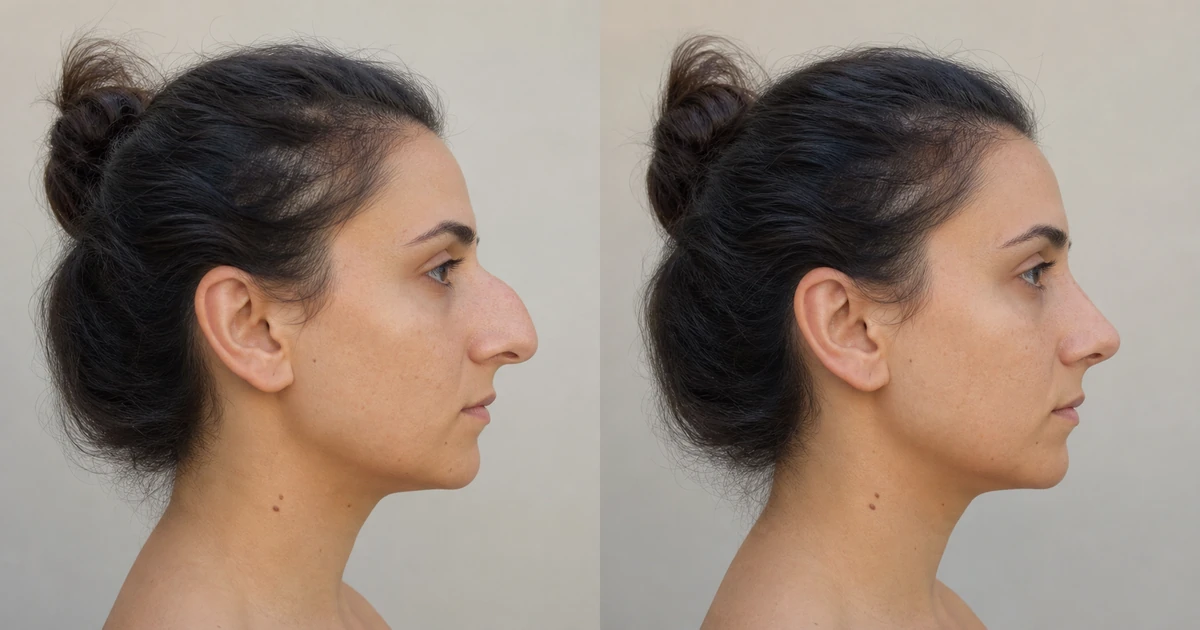
What Rhinoplasty Can Change — and How Much
According to NHS.uk on nose reshaping1, rhinoplasty falls into a few general categories:
- Nose reduction — making the nose smaller, by removing some cartilage and bone (this is the category a dorsal hump reduction generally falls under).
- Nose augmentation — making the nose larger, typically using a graft.
- Reshaping — changing the shape of the nose, including the nostrils.
Within those broad categories, surgeons in practice work at a more granular level — refining or rotating the tip, narrowing the nostrils, straightening a crooked nose, or, when needed, combining any of this with septal work (septorhinoplasty) to address a deviated septum and breathing alongside the cosmetic goal. A separate revision procedure can also refine or smooth irregularities left from a previous rhinoplasty. These are standard, well-established techniques within the field rather than a checklist itemised on NHS.uk's own page, which describes the three broader categories above.
A useful way to think about scope is in three layers: skeletal changes (the bone and cartilage framework — hump reduction, tip cartilage reshaping, straightening a deviated septum), soft-tissue changes (how the skin drapes over that framework, which is largely outside the surgeon's control and depends on your own skin thickness and elasticity), and functional changes (airway work, usually done at the same time if needed). A good consultation should walk through all three layers separately, because a patient focused purely on appearance may not realise that the skin envelope — not the surgeon's skill — is often what limits how dramatic a cosmetic change is achievable, especially in thick-skinned noses where the underlying skeletal work can be excellent but disguised by soft tissue that doesn't contract as tightly.
It can't change your face outside your nose. It can't guarantee an exact millimetre-perfect outcome — surgery is on living tissue, and cartilage and skin behave differently in every patient. A skilled surgeon can shift the odds toward a predictable result, but nobody can promise a specific number on a ruler.
It's worth being equally clear about what rhinoplasty is not designed to do. It won't correct facial asymmetry elsewhere on the face, it won't change skin texture or pore size, and it won't reliably fix chronic nasal congestion unless the underlying structural or septal problem is addressed as part of the operation. Patients who arrive expecting the nose to "fix" an unrelated area of the face, or to resolve breathing issues that are actually allergic or sinus-related, are the most likely to be disappointed even when the surgery itself goes technically well. A thorough consultation should separate cosmetic goals from functional ones and set expectations for each independently, because the healing timeline and the markers of success differ between the two.
Why Final Results Take up to a Year
Bridge swelling settles in the first three months, which is why the upper two-thirds of the nose can look close to final quite early. The nasal tip is different: the skin there is thicker, has more sebaceous glands, and drains lymphatic fluid more slowly, so it takes 6 to 12 months to fully refine, and thick-skinned patients — a group that includes many male patients and many patients of Mediterranean, African, Middle Eastern and South Asian ancestry — can take longer still, sometimes 18 months or more before the tip has lost its final residual puffiness.
A rough month-by-month picture helps set expectations: at 2 weeks most visible bruising has resolved but the nose is still swollen and numb; by 6 weeks a cast-off "new nose" shape appears but is still inflated, especially at the tip and nasal supratip; by 3 months the bridge and sides look settled while the tip is still refining; by 6 months most of the change has happened; and by 12 months the result is close enough to final that photos are meaningful for comparison. Every 2-month "after" you see on social media is a preview, not a result, and surgeons who only post early photos are — knowingly or not — showing you the most flattering, least informative stage of healing. Ask any surgeon you're considering for examples of their own patients at 12+ months, ideally with a range of skin thicknesses represented, not just their single best thin-skinned outcome.
Facial Harmony Over a "Perfect Nose"
Anatomically identical noses look different on different faces. The best rhinoplasty results balance the nose with the rest of the face — chin projection, cheekbone width, upper-lip position, brow-to-tip angle — rather than aiming for a decontextualised "ideal" shape lifted from a photo of someone else's face. A nose that would look elegant on a face with a strong chin can look disproportionately large on a face with a receding chin, which is one reason experienced surgeons sometimes discuss chin augmentation alongside rhinoplasty: a small increase in chin projection can visually "shrink" the nose without touching it at all.
Screenshots of celebrity noses, or filtered images from social media, are a poor brief for your surgeon for two reasons. First, they usually show a nose in isolation without reference to how it sits with the rest of that particular face's proportions. Second, many of the images circulating online have been digitally reshaped in ways that aren't achievable, or aren't advisable, on a different underlying bone and cartilage structure. A better approach is to discuss the specific things you dislike about your own nose — a hump, a droopy tip, asymmetry, wide nostrils — and let the surgeon translate that into a plan suited to your face, sometimes using computer imaging as a discussion tool rather than a promise of the exact outcome.
Preservation & Ethnic Approaches
Preservation techniques (keeping the dorsal cap of bone and cartilage intact and letting it down as a unit, rather than shaving it away and reconstructing the shape from smaller pieces) and ethnic rhinoplasty (an approach that explicitly respects a patient's heritage and facial features rather than pushing every nose toward one narrow template) are recognised, published approaches within the wider field, alongside the more general bridge, tip, length and width techniques described in BAPRAS patient information on rhinoplasty3. Preservation methods tend to produce a more natural-looking dorsal contour with less risk of the "operated" look sometimes associated with older resection techniques, though they aren't suitable for every nasal shape and every surgeon offers them differently.
Ethnic rhinoplasty is not a separate operation so much as a mindset and a skillset: recognising that skin thickness, cartilage strength, and typical starting proportions vary across ethnic backgrounds, and that a good result is one that fits the individual face rather than one that erases the features that make it recognisably theirs. No anatomical feature — a wider nasal base, a lower bridge, thicker skin — is a defect to be corrected by default. Patients are entitled to ask a prospective surgeon directly about their experience working with noses similar to their own, and to see examples of that specific work rather than a general portfolio.
Reading Photos Critically
- Angle: profile vs three-quarter tells different stories — a hump that's obvious side-on can be invisible from the front, and vice versa for tip asymmetry.
- Lighting: harsh, direct light exaggerates every millimetre of contour and shadow; soft, flat, diffused light can smooth over irregularities that would show up outdoors.
- Makeup: contour makeup and highlighter can make an untreated nose look narrower or straighter in a "before" photo, artificially inflating the apparent change.
- Digital editing: obvious on some social feeds once you know to look — check for warped background lines, inconsistent ear or jaw width between before and after, or unnaturally smooth skin only in the "after" image.
- Timing: 8 weeks isn't the result. If a gallery doesn't state the time since surgery, ask.
- Camera distance and lens: a closer camera with a wide-angle lens exaggerates the nose; standing further back with a longer lens flattens it. Consistent, matched setups between before and after are what make a photo pair trustworthy.
When you're assessing a surgeon's portfolio, look for consistency across their whole gallery rather than judging on one striking pair of images. A surgeon with a large, honest portfolio will show a range of outcomes, angles and skin types, including cases photographed well past the 12-month mark, and will be willing to talk you through a result that's more subtle as well as their most dramatic transformation.
A few common misconceptions are worth naming directly. "Before and after" photos taken with a smile are misleading, because the tip and nostrils move with facial expression; a fair comparison uses a neutral, relaxed face in both images. A single flattering angle isn't proof of an all-round good result — ask to see the same case from at least profile, three-quarter and frontal views. And a gallery curated to show only the most dramatic transformations, without any subtler or more borderline cases, tells you more about the surgeon's marketing than about what you can typically expect from them. A convincing gallery is no substitute for confirming the surgeon's own credentials — see the site's guide to choosing a surgeon for how to check the GMC Specialist Register and society membership before you rely on any set of photos.
When Results Disappoint: Revision Reality
BAAPS patient information on rhinoplasty2 and other specialist bodies describe revision as a genuine, non-trivial possibility rather than a rare exception, though none publish a single agreed percentage — reported rates vary considerably between studies depending on cohort, follow-up length, surgeon experience and how "revision" itself is defined. Rhinoplasty has one of the higher revision rates of any cosmetic procedure, in part because the tissues are unpredictable and small changes in scarring or cartilage healing can shift the outcome, and in part because patient expectations for the nose — a feature seen in every photo and every mirror — are unusually exacting.
Timing usually needs to be at least 12 months out from the primary surgery, and often longer if there's ongoing swelling, because operating on tissue that hasn't finished settling risks correcting a problem that would have resolved on its own, or misjudging the true shape underneath residual swelling. The operation itself is harder than a primary rhinoplasty: scar tissue replaces some of the normal anatomical planes, blood supply to the skin can be reduced from the first surgery, and there is often less cartilage available for grafting, sometimes requiring cartilage to be taken from the ear or rib rather than the septum. For UK patients weighing this up, revision surgery typically costs more than a primary procedure and sits in the region of £8,000–£12,000 or more depending on complexity and whether grafting is needed. Read the full revision rhinoplasty guide for a detailed breakdown of costs, timing and what to ask a revision specialist.
FAQ
How long until my nose looks final?
Most swelling in the bridge settles within three months, but the tip — where skin is thickest — takes 6 to 12 months to fully refine, longer still in thick-skinned patients. Judge results, and compare "after" photos, only from the 12-month mark onward, not from early post-operative images.
Can rhinoplasty keep my ethnic features?
Yes. Preservation and ethnic rhinoplasty approaches are specifically designed to refine a nose while keeping it recognisable as yours, respecting your heritage and facial proportions rather than reshaping toward one generic template. Ask a prospective surgeon about their specific experience with noses similar to yours and to see relevant examples.
How common is revision?
Not rare — rhinoplasty has one of the higher revision rates of any cosmetic procedure, though published figures vary too widely by definition, cohort and surgeon experience to quote one reliable number. Revision is usually delayed at least 12 months and can cost £8,000–£12,000 or more in the UK.